
Sleep & Circadian Disorders
Sleepwalking and Sleep Terrors in Adults
Sleepwalking and sleep terrors occur when a person partially awakens from deep sleep. During an episode, they may walk, talk, appear frightened, or perform activities without being fully aware of what is happening. They often remember little or nothing afterward.
These conditions are known as non-rapid eye movement (NREM) parasomnias. Although more common in children, they can persist or begin in adulthood. Episodes can disrupt sleep and sometimes create safety risks, particularly when someone leaves their bed or performs complex activities.
Understanding what triggers these episodes and when to seek help can support safer sleep and more effective management.
This page focuses on adults. Information is also available for Sleepwalking and sleep terrors in children and teens.
Overview
- Sleepwalking and sleep terrors are disorders of arousal that usually occur during deep non-rapid eye movement (NREM) sleep
- Sleepwalking involves getting out of bed or performing activities while not fully awake
- Sleep terrors involve sudden, intense fear, often accompanied by screaming, rapid breathing, or a racing heartbeat
- During episodes, people may appear awake but remain confused or difficult to communicate with. They often have little or no memory of what happened
- Sleep loss, irregular sleep schedules, stress, alcohol, and certain medications can increase the likelihood of episodes. Other sleep disorders may also contribute
- Management focuses on identifying possible triggers, improving sleep, and reducing safety risks. Additional treatment may be helpful when episodes are frequent or disruptive
About sleepwalking and sleep terrors
Sleepwalking and sleep terrors occur when the brain partially awakens from deep non-rapid eye movement (NREM) sleep. During these episodes, a person can move or react to their surroundings while remaining largely unaware of what is happening. Episodes most often occur during the first part of the night, when deep sleep is more common.
Sleepwalking, also called somnambulism, can involve sitting up, walking, talking, or performing familiar activities such as dressing or moving objects.
Sleep terrors, sometimes called night terrors, typically involve sudden screaming, intense fear, or signs of physical distress, such as sweating and a racing heartbeat. Some people experience features of both conditions.
Unlike nightmares, which usually occur during rapid eye movement (REM) sleep and are often remembered as vivid dreams, sleepwalking and sleep terrors generally involve confusion, limited responsiveness, and little memory of the event afterward.
Although these conditions are more common in children, episodes that begin in adulthood or involve unusual or potentially dangerous behaviors deserve further evaluation to rule out other sleep or neurological conditions.
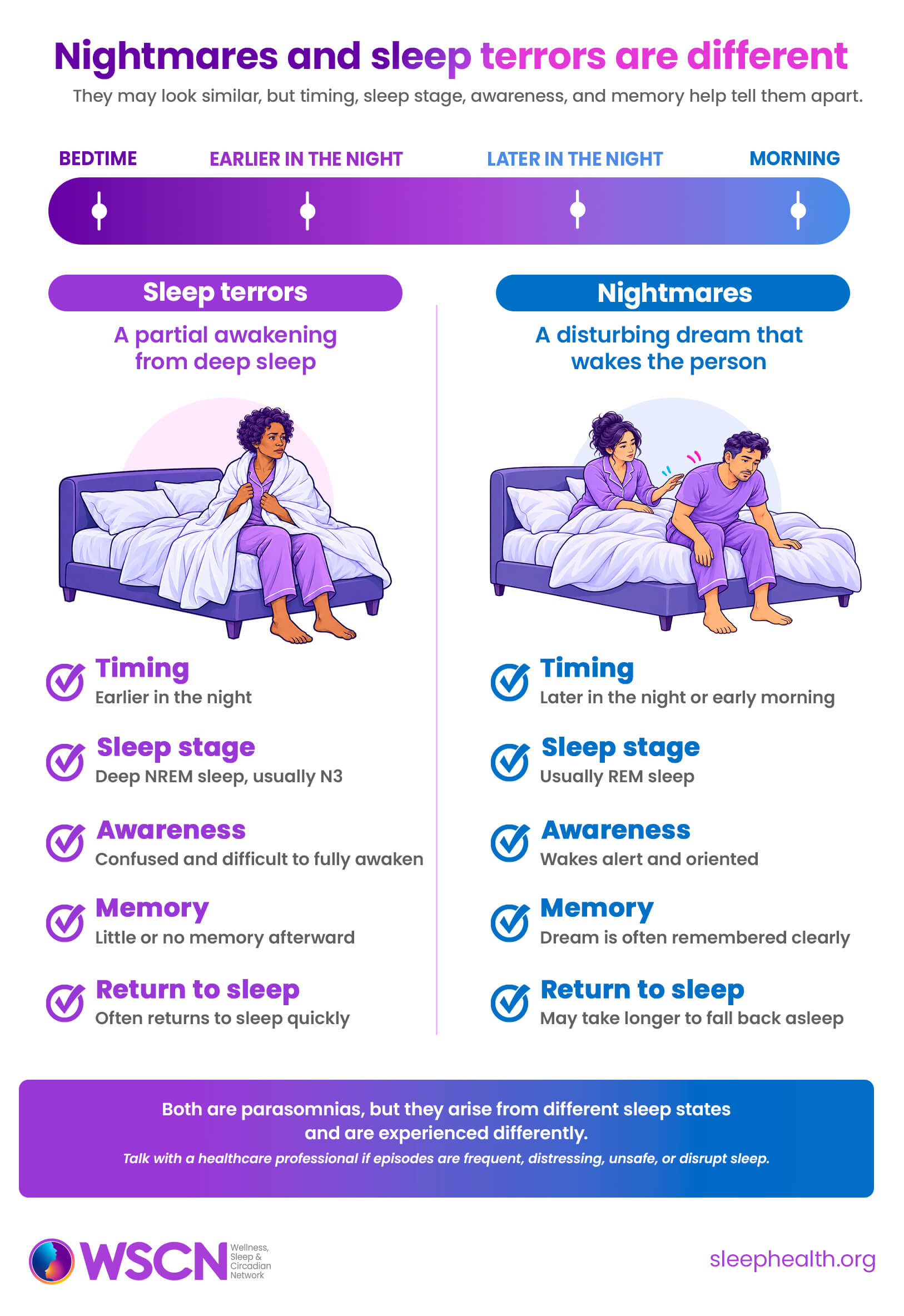
Signs and symptoms
Sleepwalking and sleep terrors share some features, including limited awareness during episodes and little memory of what happened afterward. However, their symptoms can look quite different.
Sleepwalking symptoms
During a sleepwalking episode, a person may:
- Sit up in bed, walk around, or perform familiar activities while not fully awake
- Have a blank or glassy-eyed expression
- Speak unclearly or respond in ways that do not make sense
- Move objects, get dressed, eat, or attempt to leave the home
- Be confused or difficult to communicate with when approached
- Return to bed without fully waking up
Sleep terrors symptoms
Sleep terrors involve a sudden appearance of intense fear, often with a strong physical reaction. During an episode, a person may:
- Suddenly sit upright, scream, or cry out
- Appear terrified or panicked without an obvious reason
- Have a racing heartbeat, rapid breathing, or heavy sweating
- Thrash, push someone away, or resist attempts at comfort
- Be difficult to wake or reassure
- Have little or no memory of the episode the following morning
After an episode
People experiencing either condition may have little memory of what happened. Some feel confused or disoriented if awakened during an episode.
Repeated episodes can disrupt sleep and affect daytime energy or concentration. They can also cause concern for bed partners or other household members, particularly when there is a risk of injury.
Important Note: If someone is sleepwalking or experiencing a sleep terror, stay calm and gently guide them away from danger when possible. Avoid shouting, startling, or restraining them. If there is an immediate risk of injury, waking them may be necessary.
Screening and diagnosis
Sleepwalking and sleep terrors are usually diagnosed based on a person’s symptoms and sleep history. A healthcare professional may ask when episodes occur, how frequently they happen, and whether they involve confusion, unusual behaviors, or safety concerns.
Descriptions from a bed partner or household member can be helpful, as can a safely recorded video of an episode. The assessment may also include sleep schedules, medications, and other conditions that could contribute to nighttime awakenings.
An overnight sleep study is not always necessary. However, further testing may be recommended when episodes begin in adulthood, cause injuries, or have unusual features that could suggest seizures or another sleep disorder.
When to talk with a healthcare professional
You do not need to know what is causing your symptoms before asking for help. Talk with a healthcare professional if sleep-related episodes persist, become more frequent, or begin to affect your health or daily life.
Sleepwalking and sleep terrors can often be managed. Getting support can help identify contributing factors and reduce the risk of injury.
Red Flag: Seek urgent medical care if:
- Episodes involve falls, injuries, or potentially dangerous activities, such as leaving the home
- Nighttime behaviors put you or other household members at risk of harm
- Episodes involve unusual movements or symptoms that could indicate seizures or another neurological condition
- Sleep-related symptoms make it difficult to function safely during the day
- You experience overwhelming distress or thoughts of self-harm
Serious injuries, prolonged seizures, or new neurological symptoms require emergency medical attention. Repeated unsafe nighttime behaviors warrant prompt medical evaluation, even when no injury has occurred.
What to bring to a doctor’s visit
A primary care physician is a good place to start for a sleep disorder evaluation. They can conduct preliminary screenings and recommend next steps for diagnosis. It can be helpful to bring information to an initial visit: try using WSCN’s Preparing to meet your new healthcare provider checklist..
Causes, risk factors, and health implications
Causes and risk factors
Sleepwalking and sleep terrors occur when the brain partially awakens from deep sleep. Why some people experience these episodes more frequently than others is not fully understood, but several factors can increase their likelihood:
- Biology and family history: Disorders of arousal can run in families
- Sleep pressure and timing: Sleep deprivation, irregular schedules, shift work, and jet lag may make partial arousals more likely
- Sleep fragmentation: Obstructive sleep apnea, restless legs symptoms, periodic limb movements, pain, noise, or caregiving interruptions may trigger arousals
- Stress and health changes: Acute stress, trauma symptoms, anxiety, fever, illness, and major life changes may contribute
- Alcohol, substances, and medications: Alcohol, sedatives, withdrawal, and some psychiatric or neurological medicines may alter sleep or arousal
These factors do not affect everyone in the same way. Identifying possible triggers can help guide treatment and reduce the frequency of episodes.
Health implications
Sleepwalking and sleep terrors are not generally associated with lasting physical harm unless injuries occur. However, frequent or severe episodes can affect safety, sleep, and quality of life.
- Safety: Falls, collisions, wandering, driving, or defensive movements can injure the person or someone nearby
- Sleep and daytime function: Repeated disruption may worsen alertness, concentration, work performance, and driving safety
- Mental health: Fear of sleep, shame, anxiety, trauma distress, or depression may worsen without support
- Relationships and quality of life: Household sleep loss, worry, and changing sleeping arrangements can affect connection and wellbeing
Addressing contributing factors and taking practical safety precautions can help reduce these risks and improve everyday life.
Treatment and management
Treatment for sleepwalking and sleep terrors focuses on reducing episodes, improving sleep, and preventing injuries. Many people benefit from addressing possible triggers, while frequent or severe episodes may require additional care.
Managing sleepwalking
Safety is a priority when someone walks or performs activities without being fully awake. Helpful precautions include:
- Clearing floors and removing objects that could cause injuries
- Securing windows and exterior doors while maintaining safe emergency exits
- Restricting access to stairs or other hazardous areas
- Safely storing sharp objects and other dangerous items
- Using door alarms or motion sensors when wandering is a concern
If an episode occurs, gently guide the person away from danger and back to bed when possible. Avoid shouting or forcefully restraining them, which can increase confusion.
Managing sleep terrors
Sleep terrors can be frightening to witness, but episodes usually end on their own. The priority is to keep the person safe while allowing the episode to pass.
- Stay calm and avoid trying to force the person awake
- Remove nearby objects that could cause injury if the person thrashes or moves suddenly
- Give the person space while remaining nearby to monitor their safety
- Offer reassurance once they are fully awake, if needed
Addressing triggers and related conditions
Both conditions may improve when contributing factors are addressed. Getting enough sleep, maintaining reasonably consistent sleep schedules, and managing stress can help reduce episodes.
Other sleep disorders, particularly obstructive sleep apnea, may contribute to nighttime awakenings and require separate treatment. A healthcare professional can also review medications or substances that may influence episodes.
For episodes that occur predictably, scheduled awakenings may sometimes help, although evidence in adults remains limited. Behavioral approaches may also be useful. Medication is generally considered for frequent, severe, or potentially dangerous episodes when other measures are insufficient.
Living with sleepwalking and sleep terrors
A shared household plan can reduce risk, blame and uncertainty. It may help to record episode details and daytime activities for a week or two in a sleep diary, to link episodes to possible triggers. During an event, household members can focus on immediate safety and calm redirection rather than arguing with or forcefully restraining the person.
Research and what we are still learning
Researchers are studying why the brain can remain partly asleep while allowing complex movements or intense emotional reactions to occur. They are also investigating how genetics, sleep disruption, and other health conditions contribute to sleepwalking and sleep terrors in adults.
Although both conditions are well recognized, their treatment remains less extensively studied in adults than in children. Much of the available evidence comes from small studies and clinical observations, making it difficult to determine which approaches work best.
Future research may help identify people at greater risk of recurrent episodes and injuries, while improving treatments that support safer, more restful sleep.
Castelnovo, A., Lopez, R., Proserpio, P., et al. (2018). NREM sleep parasomnias as disorders of sleep-state dissociation. Nature Reviews Neurology, 14(8), 470–481. https://doi.org/10.1038/s41582-018-0030-y
Derry, C. P., Harvey, A. S., Walker, M. C., et al. (2009). NREM arousal parasomnias and their distinction from nocturnal frontal lobe epilepsy: A video EEG analysis. Sleep, 32(12), 1637–1644. https://doi.org/10.1093/sleep/32.12.1637
Drakatos, P., Marples, L., Muza, R., et al. (2019). Video polysomnographic findings in non-rapid eye movement parasomnia. Journal of Sleep Research, 28(2), e12772. https://doi.org/10.1111/jsr.12772
Lopez, R., Jaussent, I., Scholz, S., et al. (2013). Functional impairment in adult sleepwalkers: A case-control study. Sleep, 36(3), 345–351. https://doi.org/10.5665/sleep.2446
Mainieri, G., Loddo, G., Provini, F., & Nobili, L. (2023). Diagnosis and management of NREM sleep parasomnias in children and adults. Diagnostics, 13(7), 1261. https://doi.org/10.3390/diagnostics13071261
Mundt, J. M., & Baron, K. G. (2021). Integrative behavioral treatment for NREM parasomnias: A case series. Journal of Clinical Sleep Medicine, 17(6), 1313–1316. https://doi.org/10.5664/jcsm.9186
This article is for educational purposes only and is not intended to replace professional medical advice, diagnosis, or treatment. Speak with a qualified healthcare professional about questions or concerns related to your sleep. Read full medical disclaimer
