
Sleep & Circadian Disorders
Jet Lag Disorder
Jet lag occurs when rapid travel across time zones leaves the body’s internal clock out of sync with local time. You may feel wide awake when it is time to sleep or struggle to stay alert during the day. Other common symptoms include fatigue, difficulty concentrating, and digestive discomfort.
Jet lag disorder develops when this mismatch causes sleep difficulties or excessive daytime sleepiness that interfere with daily activities. Symptoms usually improve as the body clock gradually adjusts to the new time zone.
Although jet lag cannot always be avoided, understanding how light exposure and sleep timing affect the body clock can help travelers reduce symptoms and adjust more comfortably.
Overview
- Jet lag follows rapid travel across multiple time zones, when the body clock has not yet adjusted to local time.
- Common symptoms include trouble sleeping, daytime sleepiness, fatigue, reduced concentration, mood changes, and digestive discomfort.
- Travel direction, number of time zones, light exposure, sleep loss, and individual biology influence severity.
- Diagnosis is usually based on the travel history, symptom timing, and daytime impact.
- Carefully timed light, darkness, sleep, and sometimes melatonin can support adjustment, but incorrect timing may delay recovery.
- Severe sleepiness is a safety concern – driving and other activities should be carefully considered.
About Jet Lag Disorder
The circadian system is the body’s internal 24-hour timing system. It helps regulate when we feel sleepy or alert and coordinates many other daily body functions. Light is the strongest signal that helps keep this system aligned with the day-night cycle.
When someone travels rapidly across time zones, local time changes immediately, but the body clock adjusts more gradually. As a result, a person may feel alert when it is time to sleep or sleepy when they need to be awake. Sleep loss during travel and unfamiliar surroundings can make these symptoms worse.
Jet lag disorder is a type of circadian rhythm sleep-wake disorder. It generally occurs after crossing at least two time zones and involves sleep difficulties or excessive daytime sleepiness that interfere with daily functioning.
The direction of travel also affects how the body adjusts. Eastward travel usually requires the body clock to shift earlier, which tends to be more difficult. Westward travel generally requires a later shift, which is often easier for the body to manage. However, the number of time zones crossed and individual differences also influence the severity and duration of symptoms.
Most people gradually adjust to the new time zone as their body clock becomes aligned with local time.
Social Jet Lag
Social jet lag occurs when a person’s sleep schedule is out of sync with their body’s internal clock, often because work or school schedules differ from their natural sleep preferences. For example, someone who wakes early during the week but sleeps and wakes several hours later on weekends may experience social jet lag.
Unlike travel-related jet lag, social jet lag does not involve crossing time zones. However, regularly shifting between different sleep schedules can make it harder to fall asleep or wake at the desired times. It can also affect daytime alertness and mood.
Research has linked greater social jet lag with poorer sleep and increased metabolic health risks, although these associations do not establish that social jet lag directly causes disease.
Maintaining reasonably consistent sleep and wake times throughout the week can help reduce social jet lag.
Signs and Symptoms
Jet lag symptoms vary depending on the direction of travel, the number of time zones crossed, and how much sleep someone gets during the journey. They can affect both sleep and daytime functioning.
During the intended sleep period
- Difficulty falling asleep at local bedtime
- Feeling alert at night because the body clock remains closer to home time
- Waking earlier than intended or waking repeatedly
- Sleep that feels short, light, or unrefreshing
During waking hours
- Excessive sleepiness or unintended dozing
- Fatigue or reduced physical capacity
- Slower attention, memory, reaction time, or decision-making
- Irritability, low mood, or reduced motivation
- Headache, digestive discomfort, appetite changes, or general malaise
- Reduced work, athletic, social, or caregiving function
Sleepiness and fatigue are not the same. Sleepiness means having difficulty staying awake, while fatigue refers to feeling physically or mentally drained. People with jet lag often experience both.
Symptoms usually improve as sleep, light exposure, meals, and activity become aligned with destination time.
Screening and Diagnosis
Jet lag is usually easy to recognize because symptoms develop after traveling across time zones. Most people do not need a medical evaluation or formal diagnosis, as symptoms generally improve once the body clock adjusts to local time.
When symptoms are unusually severe or last longer than expected, a healthcare professional may review the travel history and sleep patterns to determine whether jet lag or another condition is responsible. Specialized sleep testing is rarely needed.
When to talk with a healthcare professional
You do not need to know what is causing your sleep difficulties before asking for help. Talk with a healthcare professional if symptoms persist longer than expected, become unusually severe, or begin to affect your health or daily life.
Jet lag usually improves as the body clock adjusts to local time. If sleep problems continue well beyond your trip or occur without recent time-zone travel, a healthcare professional can help identify other possible causes.
Red Flag: Seek prompt or urgent help if:
- You are falling asleep while driving or performing activities where sleepiness could put you or others at risk
- Severe sleepiness makes it difficult to function safely during the day
- You experience sudden confusion, fainting, or other new neurological symptoms.You experience overwhelming distress or thoughts of self-harm
Avoid driving or other hazardous activities when you cannot remain alert. Seek emergency care for sudden severe neurological symptoms or if you are in immediate danger of harming yourself.
What to bring to a doctor’s visit
A primary care physician is a good place to start for a sleep disorder evaluation. They can conduct preliminary screenings and recommend next steps for diagnosis. It can be helpful to bring information to an initial visit: try using WSCN’s Preparing to meet your new healthcare provider checklist.
Causes, Risk Factors, and Health Implications
Causes and risk factors
Jet lag occurs when rapid travel across time zones causes the body’s internal clock to fall out of sync with local time. Several factors can influence how severe symptoms become and how long they last.
These include:
- Number of time zones crossed: Traveling across more time zones generally creates a greater mismatch between the body clock and local time.
- Direction of travel: Eastward travel is often more difficult because the body clock usually needs to shift earlier. Westward travel generally requires a later shift, which is often easier.
- Sleep loss during travel: Getting too little sleep before or during a journey can increase fatigue and daytime sleepiness.
- Light exposure: Exposure to light at the wrong time can delay the body’s adjustment to a new time zone.
- Individual differences: People vary in their natural sleep timing and how quickly their body clocks adjust.
- Travel frequency: Frequent long-distance travel with little recovery time can lead to repeated sleep and circadian disruption.
- Other contributing factors: Stress, illness, alcohol, and certain medications can worsen sleep difficulties during travel.
Not everyone experiences jet lag in the same way. Understanding which factors contribute to symptoms can help travelers plan ahead and make adjustments that support recovery.
Treatment and Management
Jet lag usually improves as the body clock adjusts to the new time zone. Several strategies can help reduce symptoms and make this adjustment easier. The goal is to support the body’s natural rhythms while protecting sleep and daytime alertness.
Before travel
- Preparing for a time-zone change can help reduce jet lag symptoms, particularly for longer journeys.
- Get enough sleep: Avoid starting your trip already sleep-deprived.
- Adjust your sleep schedule: When practical, gradually move bedtime and wake time earlier before eastward travel or later before westward travel.
- Plan for the time difference: Consider your arrival time and the number of time zones crossed when planning sleep and activities.
- Review medication schedules: If you take medications at specific times, ask your healthcare professional or pharmacist whether adjustments are needed.
During travel and after arrival
Once you arrive, the focus shifts to helping your body clock adjust while managing sleepiness safely.
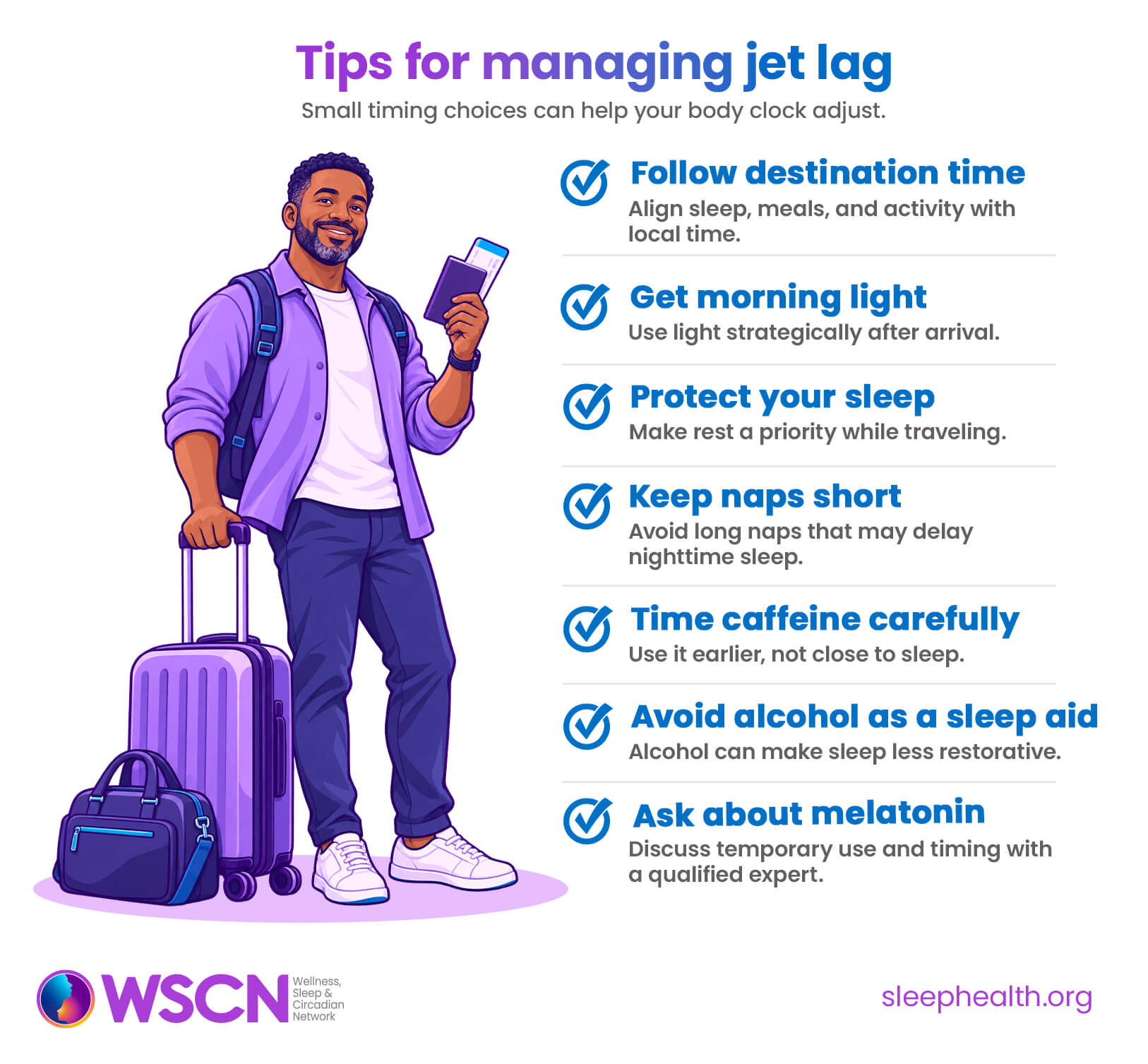
- Time your light exposure: Daylight can help reset the body clock, but the best time for exposure depends on your journey. Poorly timed light can delay adjustment, particularly after crossing many time zones.
- Follow local time: For longer trips, try to align sleep and daily activities with the destination’s schedule.
- Protect your sleep: Keep your sleeping environment quiet, dark, and comfortable.
- Use naps strategically: Short naps can temporarily improve alertness, but long or late naps can make it harder to sleep at the intended bedtime.
- Manage caffeine and alcohol: Caffeine can improve alertness temporarily but may interfere with sleep if consumed too late. Alcohol can disrupt sleep and worsen next-day fatigue.
- Keep regular meal times: Eating at local meal times can help establish a consistent daily routine, although light remains the strongest signal for adjusting the body clock.
Consider melatonin when appropriate: Melatonin can help shift the body clock when taken at the right time. Incorrect timing may delay adjustment. Ask a healthcare professional or pharmacist whether it is suitable for you, especially if you take other medications.
Living with frequent jet lag
Frequent travelers may benefit from recording routes, sleep, light exposure, melatonin or caffeine use, symptoms, and recovery time, and work out what helps or hinders jet lag symptoms. The aim is to identify a repeatable plan to optimize wellbeing.
For short trips, maintaining part of the home schedule may sometimes be more practical than fully shifting and then shifting back. For longer trips, early alignment with destination time is usually more useful.
Timing Travel, Circadian Rhythms, and Medications
Crossing time zones can make it difficult to maintain regular medication schedules. This is particularly important for medicines that must be taken at specific times or intervals to remain safe and effective.
If you take prescription medications, talk with your healthcare professional or pharmacist before traveling. They can help determine whether your dosing schedule needs to change and how to make the adjustment safely.
Do not change medication timing on your own, especially for medicines where missed or incorrectly timed doses could affect your health.
Research and What We Are Still Learning
Researchers are exploring how to personalize jet lag management based on individual sleep patterns, travel schedules, and the body’s internal clock. They are also studying whether wearable devices can help guide light exposure and track how quickly travelers adjust to new time zones.
Another area of research focuses on combining carefully timed light exposure and melatonin to improve recovery. Researchers want to understand which approaches work best for different travel directions and how to reduce symptoms without disrupting sleep further.
Although several strategies show promise, much of the available research comes from small studies or simulated time-zone changes rather than actual travel. Larger studies involving more diverse groups of travelers are needed to determine how well these approaches work in everyday life.
Arendt, J. (2018). Approaches to the pharmacological management of jet lag. Drugs, 78(14), 1419–1431. https://doi.org/10.1007/s40265-018-0973-8
Burgess, H. J., Crowley, S. J., Gazda, C. J., et al. (2003). Preflight adjustment to eastward travel: 3 days of advancing sleep with and without morning bright light. Journal of Biological Rhythms, 18(4), 318–328. https://doi.org/10.1177/0748730403253585
Erland, L. A. E., & Saxena, P. K. (2017). Melatonin natural health products and supplements: Presence of serotonin and significant variability of melatonin content. Journal of Clinical Sleep Medicine, 13(2), 275–281. https://doi.org/10.5664/jcsm.6462
Morgenthaler, T. I., Lee-Chiong, T., Alessi, C., et al. (2007). Practice parameters for the clinical evaluation and treatment of circadian rhythm sleep disorders. Sleep, 30(11), 1445–1459. https://doi.org/10.1093/sleep/30.11.1445
Parsons, M. J., Moffitt, T. E., Gregory, A. M., et al. (2015). Social jetlag, obesity and metabolic disorder: Investigation in a cohort study. International Journal of Obesity, 39(5), 842–848. https://doi.org/10.1038/ijo.2014.201
Revell, V. L., Burgess, H. J., Gazda, C. J., et al. (2006). Advancing human circadian rhythms with afternoon melatonin and morning intermittent bright light. Journal of Clinical Endocrinology & Metabolism, 91(1), 54–59. https://doi.org/10.1210/jc.2005-1009
Roenneberg, T., Allebrandt, K. V., Merrow, M., et al. (2012). Social jetlag and obesity. Current Biology, 22(10), 939–943. https://doi.org/10.1016/j.cub.2012.03.038
Rutters, F., Lemmens, S. G. T., Adam, T. C., et al. (2014). Is social jetlag associated with an adverse endocrine, behavioral, and cardiovascular risk profile? Journal of Biological Rhythms, 29(5), 377–383. https://doi.org/10.1177/0748730414550199
Scheer, F. A. J. L., Hilton, M. F., Mantzoros, C. S., et al. (2009). Adverse metabolic and cardiovascular consequences of circadian misalignment. Proceedings of the National Academy of Sciences, 106(11), 4453–4458. https://doi.org/10.1073/pnas.0808180106
Sletten, T. L., Vincenzi, S., Redman, J. R., et al. (2010). Timing of sleep and its relationship with the endogenous melatonin rhythm. Frontiers in Neurology, 1, Article 137. https://doi.org/10.3389/fneur.2010.00137
Wittmann, M., Dinich, J., Merrow, M., et al. (2006). Social jetlag: Misalignment of biological and social time. Chronobiology International, 23(1–2), 497–509. https://doi.org/10.1080/07420520500545979
This article is for educational purposes only and is not intended to replace professional medical advice, diagnosis, or treatment. Speak with a qualified healthcare professional about questions or concerns related to your sleep. Read full medical disclaimer
