
Sleep & Circadian Disorders

Irregular Sleep-Wake Rhythm Disorder

Irregular sleep-wake rhythm disorder (ISWRD) is a circadian rhythm sleep-wake disorder in which sleep and wakefulness are broken into several short, unpredictable periods across the day and night. There is no clear main sleep period. A person may be awake much of the night and sleep repeatedly during the day, or the other way around. They may also sleep for short periods during both day and night.

ISWRD is not a lack of effort or simply an inconsistent routine. It most often occurs with conditions that weaken the brain’s circadian timing system, especially Alzheimer disease and other dementias. Evaluation can clarify the pattern, identify other contributors, and guide care that supports sleep, alertness, safety, and participation throughout the day.

Overview

  • ISWRD causes sleep and wakefulness to occur in multiple short periods without a stable day-night pattern.
  • Symptoms may include nighttime insomnia with only short bouts of sleep, repeated daytime sleep, sleepiness, and difficulty sustaining alertness.
  • The disorder is most often associated with dementias, but it may also occur after brain injury or with other neurological conditions.
  • Diagnosis uses history plus a sleep diary and often actigraphy across at least 7 to 14 days.
  • Treatment aims to strengthen the contrast between day and night and set up consistent timing cues, while addressing health, medication, environmental, and safety factors.
  • Evidence is limited, so care should be individualized and regularly reviewed.

About Irregular Sleep-Wake Rhythm Disorder

The circadian system coordinates sleep and alertness with light and darkness, activity, meals, social contact, hormones, body temperature, and other daily rhythms. In ISWRD, that organizing signal is weakened or cannot reliably produce a consolidated period of sleep and a consolidated period of wakefulness.

Sleep may still add up across 24 hours, but it is divided into several episodes rather than taking place across one larger consolidated block.

The disorder is most often associated with dementia, but it may also occur after brain injury or with other neurological conditions that result in altered body clock regulation.

Signs and Symptoms

The pattern can vary from day to day. A person, family member, or caregiver may notice:

  • Sleep spread across the day and night, rather than one main nighttime period
  • Difficulty falling or staying asleep at night, sometimes with wandering, calling out, or agitation
  • Frequent or prolonged daytime naps, or unplanned sleep during daily activities
  • Reduced attention, activity, or social participation
  • Mood or behavior changes that worsen with fragmented sleep
  • Increased safety risks during walking, cooking, driving, or other tasks requiring alertness

Screening and Diagnosis

Diagnosis looks for a chronic or recurring irregular sleep-wake pattern, usually lasting at least three months, that causes insomnia symptoms, excessive sleepiness, distress, or impaired function. Because dementia or another neurological condition may affect recall, observations from a family member or caregiver can be important.

Assessment may include:

  • A sleep diary for 14 days, including sleep, naps, alertness, light exposure, meals, activity, and nighttime care
  • Wrist actigraphy to estimate sleep, rest and activity across multiple days and nights
  • Review of cognitive or neurological symptoms, mobility, pain, mood, medications, caffeine, alcohol, and other substances
  • Review of the home or care environment, including daytime light, nighttime noise and care interruptions, and opportunities for activity and social contact
  • Evaluation for sleep apnea, restless legs syndrome, medication effects, depression, delirium, insufficient sleep, or another circadian disorder

An overnight sleep study is not usually conducted, as it does not show the full multi-day pattern. However, it may be used when another sleep disorder is suspected.

When to talk with a healthcare professional

A person does not need to know the name or exact nature of a condition before asking for help. If a person experiences any of the symptoms above, it is appropriate to discuss them with a healthcare professional. 

Red Flag: Seek urgent medical care if symptoms or sleep loss are affecting a person’s ability to drive or work safely, or is causing severe distress or thoughts of self-harm.

What to bring to a doctor’s visit

A primary care physician is a good place to start for a sleep disorder evaluation. They can conduct preliminary screenings and recommend next steps for diagnosis. It can be helpful to bring information to an initial visit: try using WSCN’s Preparing to meet your healthcare provider checklist.

Causes, Risk Factors, and Health Implications

Causes and risk factors

ISWRD usually reflects reduced strength or coordination of the circadian timing system. Factors may include:

  • Neurodegenerative disease: Alzheimer disease and other dementias can affect the brain’s master circadian clock and the pathways that carry light information.
  • Brain or neurological injury: Traumatic brain injury, stroke, tumors, or other disorders may disrupt circadian pathways.
  • Aging-related changes: Circadian signals may become less robust with age, particularly when neurological disease is present.
  • Weak daytime cues: Limited daylight, low activity, irregular meals, social isolation, or spending most of the day in bed can further blur day-night differences.
  • Nighttime disruption: Pain, breathing problems, urinary symptoms, noise, light, or care tasks may fragment sleep and reinforce daytime sleeping.
  • Medication or substance effects: Sedating or stimulating medicines, caffeine, alcohol, and medication timing can alter sleep and alertness.

These factors often interact and considering whole-person health is essential for planning effective treatment and management strategies.

Long-term health implications

Evidence specific to ISWRD is limited, and associated dementia or neurological disease may account for part of the risk. Persistent sleep-wake fragmentation may contribute to:

  • Safety risks: Falls, wandering, driving impairment, and errors may become more likely when alertness is unpredictable.
  • Mental and cognitive health: Fragmented sleep may worsen mood, agitation, attention, and daily cognitive function.
  • Heart and metabolic health: Repeated circadian disruption, low activity, and irregular meals may adversely affect blood pressure, glucose regulation, and appetite, although ISWRD-specific long-term risk is not well defined.
  • Physical function: Daytime sleep and reduced activity may contribute to deconditioning (physical and mental decline due to inactivity), loss of mobility, and reduced independence.
  • Caregiver and household health: Nighttime waking can disrupt caregiver sleep, increase stress, and affect the sustainability of care.
  • Quality of life: Symptoms may limit social connection, appointments, rehabilitation, and meaningful daytime activity.

Treatment and Management

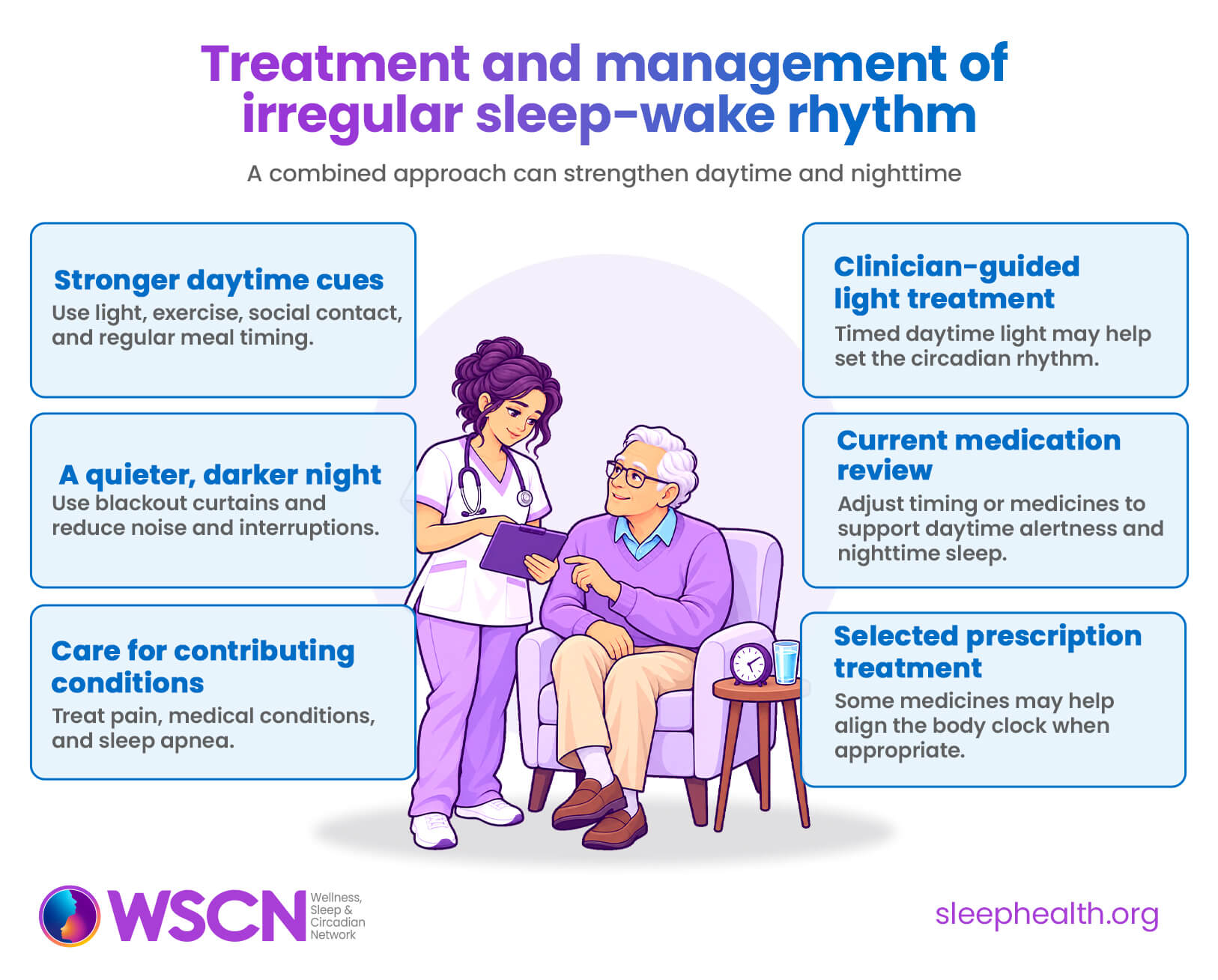
The goal is usually a more stable rhythm with longer nighttime sleep and more sustained daytime alertness—not perfect sleep. Care should address the person’s underlying condition, abilities, living environment, and caregiver capacity. Taking a whole-person approach across all 24 hours can identify the best opportunities for optimizing health and wellbeing.

Options may include:

  • Stronger daytime cues: Regular morning and daytime light, physical activity, social contact, meals, and out-of-bed time can help distinguish day from night.
  • A quieter, darker night: Reduce avoidable light, noise, and interruptions while still meeting medical and safety needs.
  • Care for contributing conditions: Treat pain, nocturia (the need to urinate during the night), sleep apnea, mood symptoms, medication effects, and other causes of fragmented sleep.
  • Clinician-guided light treatment: Trials in people with dementia suggest that appropriately delivered daytime light may improve sleep, mood, or behavior, but results vary and the best timing and dose are not settled.
  • Medication review: Sleep-promoting medicines can increase confusion, falls, or daytime sedation in some older adults. Routine melatonin or hypnotic treatment for older adults with dementia and ISWRD is not advised because evidence of benefit is limited and harms are possible.
  • Selected prescription treatment: A small exploratory trial of lemborexant in people with Alzheimer disease and ISWRD reported improvements in some rest-activity measures, but this does not establish it as appropriate for every person. A clinician must weigh benefits against the risks of sedation, falls, medication interactions, and other risks.

Light treatment should be reviewed with a clinician when a person has eye disease, bipolar disorder, light-triggered migraine, or uses medicines that increase light sensitivity.
Living with irregular sleep-wake rhythm disorder

  • Track sleep, naps, alertness, light, activity, meals, symptoms, and safety concerns for at least two weeks.
  • Use a consistent but realistic daily structure; introduce changes gradually.
  • Schedule demanding tasks for the person’s most alert periods.
  • Build safe daytime movement and meaningful activity into the care plan.
  • Use night-lights, clear walking paths, door or motion alerts, and mobility support when appropriate.
  • Avoid driving or hazardous tasks during sleepy periods.
  • Share observations and care goals across family, home-care, and clinical teams.
  • Reassess the plan after illness, hospitalization, medication changes, or a change in living environment.

Progress may mean fewer long daytime sleep episodes, less nighttime disruption, or safer and more predictable routines. Persistent symptoms do not mean that the person or caregiver has failed.

Research and What We Are Still Learning

Research on ISWRD remains limited, and many studies include small groups of older adults with dementia rather than people with a confirmed ISWRD diagnosis. Recent light exposure studies report improvements in selected sleep, mood, behavior, or quality-of-life outcomes, but not every study improves the rest-activity rhythm itself.

Larger trials are needed to define who benefits, how light and activity should be timed, how treatment works outside residential care, and which outcomes matter most to patients and caregivers. Future studies should measure safety, daytime function, caregiver sleep, participation, and quality of life as well as nighttime sleep.

References

Auger, R. R., Burgess, H. J., Emens, J. S., et al. (2015). Clinical practice guideline for the treatment of intrinsic circadian rhythm sleep-wake disorders: Advanced sleep-wake phase disorder, delayed sleep-wake phase disorder, non-24-hour sleep-wake rhythm disorder, and irregular sleep-wake rhythm disorder. Journal of Clinical Sleep Medicine, 11(10), 1199–1236. https://doi.org/10.5664/jcsm.5100

Bromundt, V., Wirz-Justice, A., Boutellier, M., et al. (2019). Effects of a dawn-dusk simulation on circadian rest-activity cycles, sleep, mood and well-being in dementia patients. Experimental Gerontology, 124, 110641. https://doi.org/10.1016/j.exger.2019.110641

Figueiro, M. G., Plitnick, B., Roohan, C., et al. (2019). Effects of a tailored lighting intervention on sleep quality, rest-activity, mood, and behavior in older adults with Alzheimer disease and related dementias: A randomized clinical trial. Journal of Clinical Sleep Medicine, 15(12), 1757–1767. https://doi.org/10.5664/jcsm.8078

Figueiro, M. G., Sahin, L., Kalsher, M., et al. (2020). Long-term, all-day exposure to circadian-effective light improves sleep, mood, and behavior in persons with dementia. Journal of Alzheimer’s Disease Reports, 4(1), 297–312. https://doi.org/10.3233/ADR-200212

Moline, M., Thein, S., Bsharat, M., et al. (2021). Safety and efficacy of lemborexant in patients with irregular sleep-wake rhythm disorder and Alzheimer’s disease dementia: Results from a phase 2 randomized clinical trial. The Journal of Prevention of Alzheimer’s Disease, 8(1), 7–18. https://doi.org/10.14283/jpad.2020.69

Videnovic, A., & Cai, A. (2025). Irregular sleep-wake rhythm disorder: From the pathophysiologic perspective to the treatment. Handbook of Clinical Neurology, 206, 71–87. https://doi.org/10.1016/B978-0-323-90918-1.00006-X

Wahnschaffe, A., Nowozin, C., Haedel, S., et al. (2017). Implementation of dynamic lighting in a nursing home: Impact on agitation but not on rest-activity patterns. Current Alzheimer Research, 14(10), 1076–1083. https://doi.org/10.2174/1567205014666170608092411


Medical disclaimer
This article is for educational purposes only and is not intended to replace professional medical advice, diagnosis, or treatment. Speak with a qualified healthcare professional about questions or concerns related to your sleep. Read full medical disclaimer