
Sleep & Circadian Disorders
Pediatric Bedwetting
Pediatric bedwetting, also called nocturnal enuresis, means repeated urine leakage during sleep in a child age 5 or older. It is common, involuntary, and not caused by laziness, defiance, or poor parenting. Nighttime bladder control develops at different ages. Bedwetting can reflect several interacting factors: the kidneys making more urine overnight, the bladder holding less than expected, and the sleeping brain not responding fully to bladder signals.
Primary bedwetting means a child has never been consistently dry at night. Secondary bedwetting begins after at least six dry months and may signal a new medical condition, sleep problem, or source of stress. Monosymptomatic bedwetting occurs without daytime bladder symptoms; non-monosymptomatic bedwetting includes daytime urgency, frequent urination, leakage, holding behaviors, or difficulty emptying the bladder.
Some children wet only occasionally; others wet most nights or more than once a night. Frequency alone does not show how much help a family needs. The child’s age, daytime symptoms, previous dryness, health, sleep, bowel habits, emotional impact, and readiness for change all matter. A child who is unconcerned may need reassurance, while a child avoiding activities or feeling ashamed may benefit from earlier support.
Bedwetting can disrupt sleep, sleepovers, travel, camps, confidence, and family routines across the whole 24 hours. Shame and punishment can increase distress but do not solve the underlying problem. Calm, practical support helps protect a child’s wellbeing while the cause is evaluated.
Symptoms and evaluation
The main sign of pediatric bedwetting is repeated urination during sleep in a child aged 5 or older. Some children have never been consistently dry at night, while others begin wetting again after at least six months of dry nights.
Other symptoms to watch for include:
- Daytime bladder problems: Frequent urination, sudden urgency, or urine leakage during the day.
- Difficulty urinating: Pain, straining, or a weak urine stream.
- Constipation: Hard or painful bowel movements, sometimes accompanied by abdominal discomfort.
- Sleep-related breathing problems: Loud snoring, gasping, or pauses in breathing during sleep.
- Changes in thirst or urination: Excessive thirst or unusually large amounts of urine.
- Emotional effects: Embarrassment, changes in mood, or avoiding sleepovers and other activities.
These symptoms can help healthcare professionals identify possible contributing conditions. Bedwetting that begins again after a long dry period or occurs alongside daytime urinary symptoms deserves particular attention.
Risk factors and contributors
Bedwetting often runs in families and becomes less common as children grow. It can occur when nighttime bladder control is still developing, the bladder holds relatively little urine, or the body produces more urine during sleep.
Other contributing factors include:
- Constipation: A full bowel can affect bladder function and contribute to nighttime wetting.
- Bladder problems: Some children also experience urinary urgency or leakage during the day.
- Sleep-related breathing problems: Obstructive sleep apnea is associated with bedwetting in some children.
- Medical or developmental conditions: Certain health conditions, including urinary tract infections and neurodevelopmental differences, can contribute to bedwetting.
Bedwetting that begins again after a child has been dry for at least six months can sometimes follow major life changes or emotional distress. However, medical causes should also be considered.
Identifying contributing factors can help healthcare professionals recommend appropriate treatment and support.
When to talk with a healthcare professional
You do not need to know what is causing your child’s bedwetting before asking for help. Talk with a pediatrician if bedwetting continues beyond age 5 and concerns your child or family, or begins to affect your child’s confidence or daily activities.
Medical evaluation is particularly important if bedwetting begins again after at least six months of dry nights or occurs alongside daytime urinary symptoms. Effective treatments are available, and getting support can help identify an approach that works for your child.
Red Flags: Seek prompt or urgent help if:
- Your child experiences pain when urinating, fever, or blood in the urine
- Bedwetting is accompanied by excessive thirst, frequent urination, or unexplained weight loss
- Your child develops new weakness, numbness, or difficulty walking
- Your child has difficulty emptying their bladder or experiences continuous urine leakage
New weakness or difficulty walking alongside bladder symptoms requires urgent medical assessment. Excessive thirst with weight loss or signs of significant illness also warrants prompt evaluation.
Treatment and management
Although bedwetting occurs during sleep, daytime bathroom habits and fluid intake can influence nighttime bladder control. Constipation and other health conditions can also contribute.
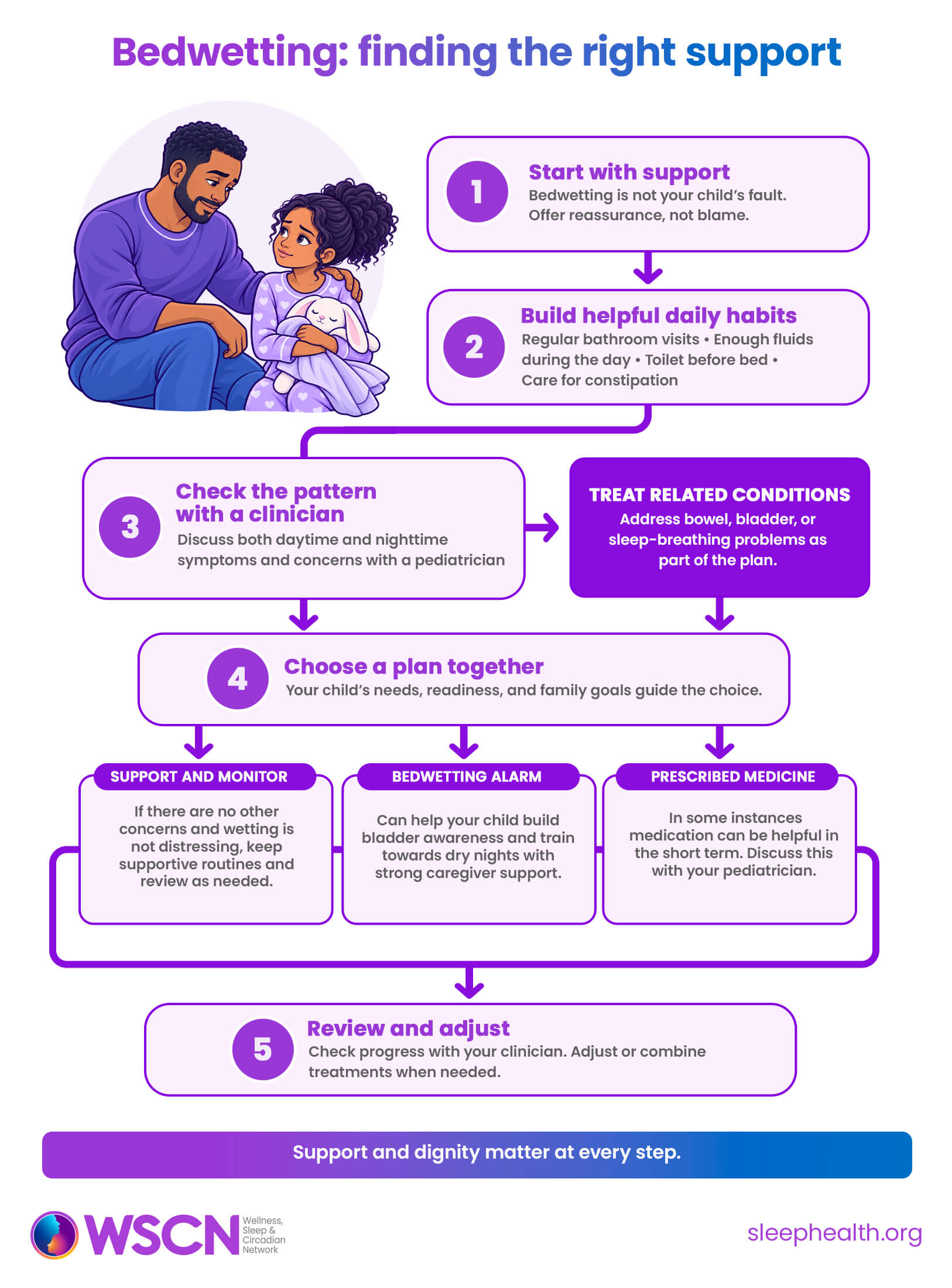
Treatment depends on the child’s age and symptoms, as well as their readiness and the family’s preferences. Options range from practical changes to daily routines to bedwetting alarms or medication when appropriate.
The goal is to improve nighttime bladder control while supporting the child’s confidence and well-being.
Education and reassurance
The first step is reducing blame. Children may feel embarrassment or shame about bedwetting, since there may be a perception that “big kids” are not supposed to wet the bed. However, bedwetting is not a matter of willpower or chosen behavior – it is something that happens during sleep and is not under the child’s control.
Children should not be punished for bedwetting. Not only will punishment be unhelpful for fixing the problem, but it may cause anxiety that makes the problem worse. Supportive language helps the child stay engaged and honest about symptoms. It may be helpful to frame bedwetting as a challenge that the parent and child will resolve together by using practical solutions.
Daytime routines and bowel care
A child who does not urinate regularly during the day may reach bedtime with a bladder pattern that is harder to manage overnight. Additionally, constipation can press on the bladder and reduce bladder capacity. Basic supports to manage daytime toileting may include:
- Regular daytime bathroom visits
- Treating constipation when present
- Drinking enough fluids earlier in the day
- Reducing large drinks close to bedtime when appropriate
- Avoiding caffeine-containing drinks
- Urinating before sleep
- Using a simple tracking diary
These steps are not a cure for every child, but they can strengthen the treatment plan and help identify patterns.
Enuresis alarms
Bedwetting alarms detect moisture and sound when urination begins. Over time, they can help children recognize bladder signals and respond by waking to use the bathroom. Alarms are an effective treatment for many children, but they require patience and consistent use. Parents may initially need to help their child wake when the alarm sounds.
Improvement can take several weeks or months. Early signs of progress may include smaller wet patches or waking more readily to the alarm, even before dry nights become more frequent.
A pediatrician can help determine whether an alarm is appropriate for the child and family.
Desmopressin
Desmopressin is a medication that reduces urine production overnight. It can help some children stay dry, particularly when short-term improvement is needed for activities such as sleepovers or camps.
Because drinking too much fluid while taking desmopressin can cause dangerously low sodium levels, families must carefully follow the prescribing clinician’s instructions. Fluid intake is generally restricted from one hour before taking the medication until eight hours afterward.
Bedwetting can return when treatment stops, so desmopressin does not necessarily provide a lasting solution. A pediatrician can help determine whether it is appropriate for your child.
Treating related conditions
Treating underlying health conditions can help improve nighttime bladder control. These may include constipation, urinary tract infections, or bladder problems that also cause daytime symptoms.
Obstructive sleep apnea can also contribute to bedwetting in some children. If your child snores regularly or has breathing pauses during sleep, talk with a pediatrician about further evaluation.
For more information, see our page on Pediatric obstructive sleep apnea.
Living with bedwetting
Managing bedwetting involves practical support that protects a child’s comfort and confidence. Waterproof mattress covers and easy access to clean bedding can make wet nights easier to manage. Children can help with cleanup in age-appropriate ways, but this should never be treated as punishment.
Absorbent products, such as nighttime pull-ups, can help manage wet nights and make activities such as sleepovers or travel easier. Families may also consider a trial without them as part of a treatment plan, depending on the child’s readiness and needs.
Soft nightlights can make nighttime bathroom visits safer and more comfortable without exposing children to bright light that may make it harder to return to sleep.
For sleepovers, camps, or travel, families can plan ahead with extra clothing, absorbent products, or support from a trusted adult. The goal is to help children participate in everyday activities without embarrassment or unnecessary restrictions.
Conditions associated with pediatric bedwetting
Bedwetting can occur alongside other bladder or bowel problems, including constipation and daytime urinary urgency. Obstructive sleep apnea is also associated with nighttime wetting in some children.
Less commonly, bedwetting can be related to urinary tract infections, diabetes, or neurological conditions. Certain medications may also contribute to nighttime wetting.
Bedwetting that begins again after a child has been dry for at least six months deserves particular attention, especially when accompanied by new urinary symptoms or other health concerns.
A healthcare professional can help identify contributing conditions and determine whether additional testing or treatment is needed.
Adisu, M. A., Habtie, T. E., Munie, M. A., et al. (2025). Global prevalence of nocturnal enuresis and associated factors among children and adolescents: A systematic review and meta-analysis. Child and Adolescent Psychiatry and Mental Health, 19, 23. https://doi.org/10.1186/s13034-025-00880-x
Harris, J., Lipson, A., & Dos Santos, J. (2023). Evaluation and management of enuresis in the general paediatric setting. Paediatrics & Child Health, 28(6), 362–368. https://doi.org/10.1093/pch/pxad023
Kuwertz-Bröking, E., & von Gontard, A. (2018). Clinical management of nocturnal enuresis. Pediatric Nephrology, 33(7), 1145–1154. https://doi.org/10.1007/s00467-017-3778-1
Nevéus, T., Fonseca, E., Franco, I., et al. (2020). Management and treatment of nocturnal enuresis—An updated standardization document from the International Children’s Continence Society. Journal of Pediatric Urology, 16(1), 10–19. https://doi.org/10.1016/j.jpurol.2019.12.020
Ong, L. M., Chan, J. M. F., Koh, G. E. M. Y., et al. (2024). Approach to nocturnal enuresis in children. Singapore Medical Journal, 65(4), 242–248. https://doi.org/10.4103/singaporemedj.SMJ-2021-273
Zhu, B., Zou, K., He, J., et al. (2021). Sleep monitoring of children with nocturnal enuresis: A narrative review. Frontiers in Pediatrics, 9, 701251. https://doi.org/10.3389/fped.2021.701251
This article is for educational purposes only and is not intended to replace professional medical advice, diagnosis, or treatment. Speak with a qualified healthcare professional about questions or concerns related to your sleep. Read full medical disclaimer
