
Sleep & Circadian Health
Wearable Sleep Tech
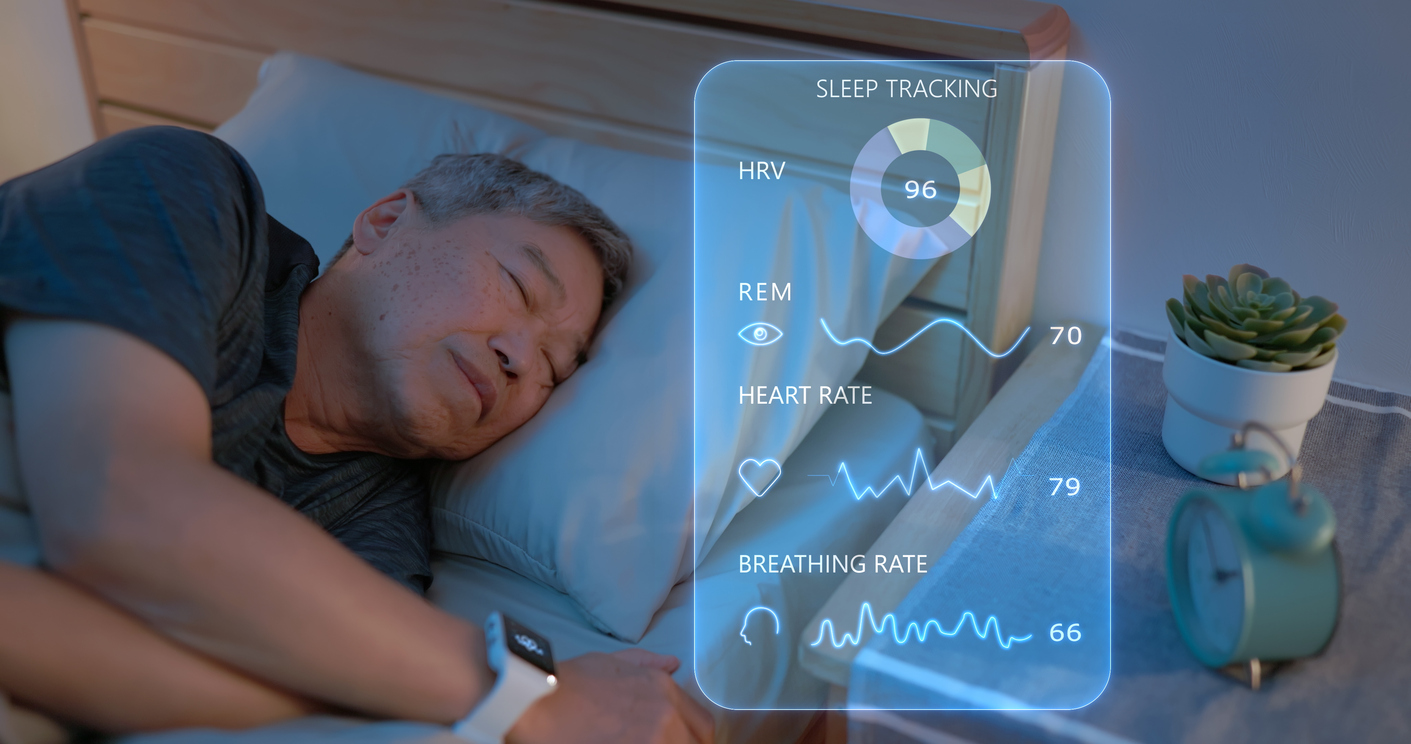
Smartwatches, rings, and bedside sleep trackers offer new ways to understand our sleep patterns and how they relate to our health. While these technologies can provide useful insights, they also have limitations. A sleep score, for example, cannot tell us everything about how well we sleep.
Understanding what sleep trackers can and cannot measure can help us make better use of the information they provide and support healthier sleep habits across all 24 hours.
Overview
- Wearables estimate sleep indirectly from movement, heart rate and blood oxygen levels
- Wearables detect sleep well but are less reliable for detecting wakefulness and specific sleep stages
- Accuracy of wearables is assessed against polysomnography, known as the “gold standard” for assessing and diagnosing sleep disorders
- Consumer wearables are most useful for revealing personal patterns and trends but cannot yet diagnose a sleep disorder
- Including your wearable device data in conversations with your health professional can add value and important insights about your wellbeing
Benefits of sleep trackers
Sleep trackers can help us better understand our sleep habits and identify opportunities for improvement. Some of the most useful benefits include:
- Understanding sleep patterns: See when you typically fall asleep and wake up, how much sleep you get, and whether your schedule is consistent.
- Recognizing what affects sleep: Explore how factors such as exercise, caffeine, alcohol, or stress relate to your sleep patterns.
- Making positive changes: Use longer-term trends to see whether adjustments to your sleep routine are making a difference.
- Supporting medical conversations: Share sleep patterns and concerns with a healthcare professional to help guide further assessment.
Sleep trackers also have limitations. Focusing too much on nightly scores can create unnecessary worry about sleep, sometimes called orthosomnia. A good sleep score does not necessarily mean someone is sleeping well, and trackers cannot reliably identify or rule out sleep disorders.
Types of wearable sleep technology
Sleep trackers use sensors to collect information about movement, heart rate, and sometimes skin temperature or blood oxygen levels. They use this information to estimate when we sleep and wake, how long we sleep, and sometimes our sleep stages.
Several types of devices are available:
- Smartwatches and fitness bands: Devices such as Apple Watch, Fitbit, and Garmin track movement and heart rate to estimate sleep duration, timing, and sleep stages.
- Smart rings: Devices such as Oura, Samsung Galaxy Ring, and Ultrahuman track similar signals through sensors worn on a finger. Some people find rings more comfortable to wear at night.
- Clinical actigraphy devices: These wrist-worn devices primarily measure movement and are used by healthcare professionals to assess sleep-wake patterns over time, often alongside a sleep diary.
- Bed and bedside trackers: Under-mattress sensors, bedside devices, and some smartphone apps estimate sleep without requiring a wearable device. They may use movement, breathing patterns, or sound, although accuracy varies.
All these devices estimate sleep using information collected by their sensors. They do not measure sleep in the same way as a clinical sleep study, which records brain activity and other physiological signals.
Bed and bedside sleep trackers
Some trackers, sometimes called “nearables,” measure sleep without touching the body. Like wearable devices they use clever algorithms to estimate sleep and awake times based on the biometric information they capture. Commonly used nearables include:
- Under-mattress pads: Pads often measure breathing, heart rate, and movement.
- Bedside devices: These devices use low-energy radar or sound waves to sense breathing and movement.
- Smart mattresses and phone apps: Some mattresses can estimate sleep from built-in sensors, sound, or motion, which then connect to an app/
Nearables may suit people who prefer not to wear a device overnight, but bed partners or pets may affect readings, and accuracy varies widely.
How to make the most of your sleep tracker
Sleep trackers are most useful when they help you understand your habits and make informed decisions about your sleep. Here are some practical ways to use them:
- Focus on sleep duration and timing: Pay attention to how much sleep you get and when you typically fall asleep and wake up.
- Look for patterns over time: Compare several weeks of data rather than focusing on a single night’s results.
- Connect sleep with daily habits: Notice whether changes in exercise, caffeine intake, or bedtime routines seem to affect your sleep.
- Consider how you feel: Compare your tracker data with how rested and alert you feel during the day. A low sleep score does not always mean you slept poorly.
- Make small adjustments: Use what you learn to develop sleep habits that work for your daily life rather than aiming for perfect scores.
If you have ongoing sleep difficulties or excessive daytime sleepiness, share your concerns and relevant tracking data with a healthcare professional. A tracker can provide useful context but cannot replace a medical evaluation.
What does a sleep score mean?
Many sleep trackers provide a nightly sleep score that summarizes different aspects of sleep in a single number. Depending on the device, this may include sleep duration, sleep timing, nighttime awakenings, and estimated sleep stages. Some devices also consider heart rate and other physiological signals.
Each manufacturer uses its own algorithm to calculate the score, so a score of 85 on one device does not necessarily mean the same thing as 85 on another.
Sleep scores can help identify patterns over time, but they do not provide a complete picture of sleep quality. For example:
- A late night: Your score may drop after staying out late because you slept fewer hours than usual.
- Afternoon caffeine: A coffee late in the day might make it harder to fall asleep, which could affect your score.
- Illness or stress: Changes in sleep duration or nighttime awakenings may be reflected in your score.
- A good score but poor sleep: Your tracker may report a high score even though you woke up feeling tired or unrefreshed.
Rather than focusing on individual scores, look for patterns across several nights or weeks. Consider how the results compare with how rested and alert you feel during the day.
Your experience of sleep is just as valuable as the numbers on your device. Sleep scores can provide useful feedback, but they are not a definitive measure of sleep health.
How accurate are sleep wearables and trackers?
Sleep wearables are assessed for performance against the “gold standard” of polysomnography (clinical sleep studies). Researchers will look at whether a device is able to correctly measure when person is asleep or awake compared to a clinical sleep study done at the same time.
There are four terms that can help you understand a device’s performance:
- Sensitivity describes how well a device correctly identifies periods when a person is asleep
- Specificity describes how well a device correctly identifies periods of awakeness
- Accuracy describes how close a device is compared to a reliable reference measurement
- Validity concerns whether a device actually measures what it claims to measure
Many wearable devices are good at identifying when someone is asleep, but less reliable at detecting periods of wakefulness. Because they rely on movement and other indirect signals, they may mistake lying quietly awake for being asleep.
Accuracy varies greatly. Some devices are highly accurate when used in particular groups of people but this accuracy changes when applied to different populations. For example – wearables are often quite accurate when measuring sleep in healthy individuals, but this accuracy reduces for people living with a sleep disorder. Device quality and individual factors also influence how accurate a device is.
Validity describes whether a device measures what it claims to measure. Consumer sleep trackers use signals such as movement and heart rate to estimate sleep, while polysomnography (a clinical sleep study) records brain activity, eye movements, and muscle activity to identify sleep stages.
Although some wearables produce results that closely match clinical sleep studies, this does not mean all their measurements are equally reliable. For example, a device may estimate total sleep time reasonably well but be less accurate at identifying specific sleep stages.
Validity also depends on how and in whom a device is tested. A tracker that performs well in healthy adults may be less reliable in people with sleep disorders. This is why consumer sleep data can provide useful insights but should not replace clinical testing when a sleep disorder is suspected.
Looking to the future of wearable technology
Sleep trackers are evolving quickly, with improved hardware and increasing algorithmic accuracy. Some consumer devices now have FDA-approved features that can suggest the presence of sleep disorders like sleep apnea. Actigraphy now has established applications in evaluating insomnia, insufficient sleep and circadian rhythm sleep-wake disorders.
In the near future, it is likely that wearable consumer devices may be able to reach a level of accuracy and validity that will allow them to collect and interpret medical-grade information. This means they could move from being personal health devices to clinical assessment tools. Take-home testing could mean better access to assessments and diagnosis for people living with a sleep disorder by bypassing the long wait times often associated with clinical sleep studies and other testing.
As technology progresses, wearables offer an opportunity for more personalized medicine. By gathering a person’s data over longer periods of time, wearables can build a fuller picture of their sleep and activity patterns. This information can help a trained health professional assess the patient and tailor treatment options to the individual’s needs.
It is an exciting time for technology in medicine, and wearable technology will continue to evolve in ways that help us understand health and wellbeing more deeply.
Abd-alrazaq, A., Aslam, H., AlSaad, R., et al. (2024). Detection of sleep apnea using wearable AI: Systematic review and meta-analysis. Journal of Medical Internet Research, 26, e58187. https://doi.org/10.2196/58187
Baron, K. G., Abbott, S., Jao, N., et al. (2017). Orthosomnia: Are some patients taking the quantified self too far? Journal of Clinical Sleep Medicine, 13(2), 351–354. https://doi.org/10.5664/jcsm.6472
Chinoy, E. D., Cuellar, J. A., Huwa, K. E., et al. (2021). Performance of seven consumer sleep-tracking devices compared with polysomnography. Sleep, 44(5), zsaa291. https://doi.org/10.1093/sleep/zsaa291
Kapur, V. K., Auckley, D. H., Chowdhuri, S., et al. (2017). Clinical practice guideline for diagnostic testing for adult obstructive sleep apnea: An American Academy of Sleep Medicine clinical practice guideline. Journal of Clinical Sleep Medicine, 13(3), 479–504. https://doi.org/10.5664/jcsm.6506
Khosla, S., Deak, M. C., Gault, D., et al. (2018). Consumer sleep technology: An American Academy of Sleep Medicine position statement. Journal of Clinical Sleep Medicine, 14(5), 877–880. https://doi.org/10.5664/jcsm.7128
Lee, T., Cho, Y., Cha, K. S., et al. (2023). Accuracy of 11 wearable, nearable, and airable consumer sleep trackers: Prospective multicenter validation study. JMIR mHealth and uHealth, 11, e50983. https://doi.org/10.2196/50983
Smith, M. T., McCrae, C. S., Cheung, J., et al. (2018). Use of actigraphy for the evaluation of sleep disorders and circadian rhythm sleep-wake disorders: An American Academy of Sleep Medicine clinical practice guideline. Journal of Clinical Sleep Medicine, 14(7), 1231–1237. https://doi.org/10.5664/jcsm.7230
Svensson, T., Madhawa, K., NT, H., et al. (2024). Validity and reliability of the Oura Ring Generation 3 (Gen3) with Oura sleep staging algorithm 2.0 (OSSA 2.0) when compared to multi-night ambulatory polysomnography: A validation study of 96 participants and 421,045 epochs. Sleep Medicine, 115, 251–263. https://doi.org/10.1016/j.sleep.2024.01.020
Windred, D. P., Burns, A. C., Lane, J. M., et al. (2024). Sleep regularity is a stronger predictor of mortality risk than sleep duration: A prospective cohort study. Sleep, 47(1), zsad253. https://doi.org/10.1093/sleep/zsad253
This article is for educational purposes only and is not intended to replace professional medical advice, diagnosis, or treatment. Speak with a qualified healthcare professional about questions or concerns related to your sleep. Read full medical disclaimer
