
Sleep & Circadian Health
Sleep Stages and Cycles
Sleep is not a single, continuous process. Throughout the night, the brain and body move through different stages of sleep. These stages repeat in cycles, with the pattern changing as the night progresses.
Each stage plays an important role in supporting brain and body health. Understanding how these stages work together can help explain why both the amount and quality of sleep matter.
Overview
- Sleep has two main types: non-REM (NREM) sleep and rapid eye movement (REM) sleep
- Non-REM sleep includes three stages, ranging from light sleep to deep sleep
- REM sleep is closely linked to vivid dreaming and plays a role in learning, memory, and emotional processing
- Throughout the night, we move through several sleep cycles, each typically lasting around 90 to 110 minutes in adults
- Deep sleep is more common earlier in the night, while REM sleep periods generally become longer toward morning
- Different sleep stages support different functions, and all contribute to healthy sleep
- Getting enough uninterrupted sleep allows the brain and body to move naturally through these stages
Stages of Sleep
Sleep is divided into two main types:
Non-rapid eye movement (non-REM or NREM) sleep: Includes three stages, ranging from light sleep to deep sleep.
Rapid eye movement (REM) sleep: A stage when the brain becomes more active and vivid dreaming is common.
Both types of sleep support important functions in the brain and body. Throughout the night, we move between them in repeating cycles.
Non-REM Sleep
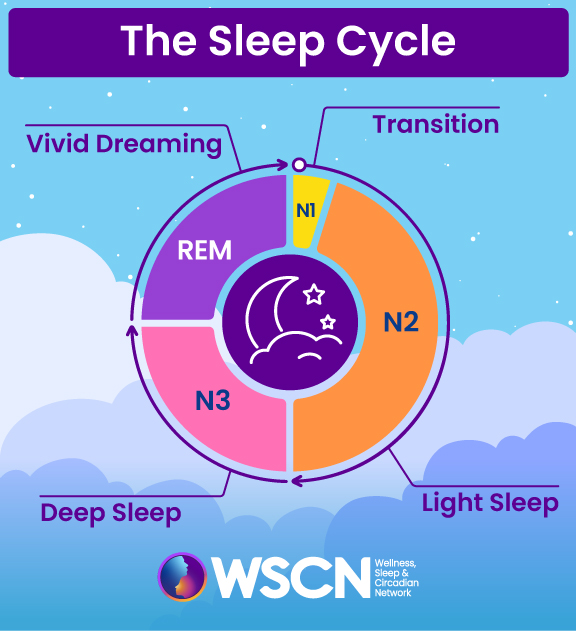
NREM sleep has three stages, N1, N2 and N3, each with unique characteristics.
N1: Light sleep
N1 is the transition from wakefulness to sleep. The body begins to relax, awareness fades, and it is still easy to wake up. Some people experience brief muscle twitches or a sensation of falling.
N2: Stable sleep
During N2, breathing and heart rate slow, and body temperature drops. The brain produces activity patterns that help maintain sleep and support learning and memory. N2 typically accounts for the largest portion of sleep in adults.
N3: Deep sleep
N3 is the deepest stage of non-REM sleep, when brain activity slows and waking becomes more difficult. Deep sleep supports physical recovery, immune function, and memory. It is most common during the first part of the night and generally decreases with age.
REM Sleep
During rapid eye movement (REM) sleep, the brain becomes more active, while most of the body’s muscles temporarily relax and become inactive. The eyes move rapidly behind closed eyelids, and breathing and heart rate can become less regular.
REM sleep is closely associated with vivid dreaming, although dreams can occur during other sleep stages too. Research suggests that REM sleep plays an important role in emotional processing, learning, and memory.
REM sleep periods are usually shorter early in the night and become longer toward morning. This is one reason why getting enough sleep matters: cutting sleep short can reduce the amount of REM sleep we get.
Both REM and non-REM sleep support important functions, and neither should be considered more important than the other.
What is a sleep cycle?
A sleep cycle is the progression through different stages of non-REM and REM sleep. In adults, a cycle typically lasts around 90 to 110 minutes, although the length can vary. Sleep cycles are shorter in young children and gradually become longer as they grow.
Throughout the night, we move through several cycles. Deep sleep is generally more common earlier in the night, while REM sleep periods become longer toward morning. Brief awakenings between cycles are normal and often go unnoticed.
Why sleep cycles matter
Sleep cycles allow the brain and body to move through different stages that support healthy functioning. Each stage contributes in different ways, from physical recovery to learning and memory.
Rather than trying to maximize deep sleep or REM sleep, the goal is to get enough good-quality sleep so the body can move naturally through its sleep cycles. Regular sleep patterns and fewer interruptions help support this process.
What happens if sleep cycles are disrupted?
Sleep cycles can be disrupted when sleep is repeatedly interrupted, cut short, or affected by a sleep disorder. This can interfere with the brain and body’s natural progression through the different stages of sleep.
Disrupted sleep can affect how we feel and function throughout the day, including:
- Daytime sleepiness and fatigue: Feeling tired or sleepy, even after spending enough time in bed
- Difficulty concentrating: Problems with attention, memory, and learning
- Mood changes: Increased irritability, low mood, or difficulty managing stress
- Reduced daily functioning: Feeling less alert and finding everyday activities more challenging
Common causes include frequent awakenings, breathing problems such as sleep apnea, and alcohol or certain medications that affect normal sleep patterns.
Over time, ongoing sleep disruption can also affect physical and mental health.
Healthy sleep is about more than the number of hours we sleep. Sleep quality and continuity also matter, allowing the brain and body to move naturally through the different stages of sleep.
How are sleep cycles measured?
Sleep stages and cycles can be measured during an overnight sleep study, called polysomnography. Sensors record brain activity, eye movements, and muscle activity to identify the different stages of sleep. Other measurements, such as breathing and oxygen levels, help clinicians assess sleep quality and identify possible sleep disorders.
| Sleep Stage | Sleep Study Findings |
|---|---|
| NREM 1 |
|
| NREM 2 |
|
| NREM 3 |
|
| REM |
|
Can wearables measure sleep stages?
Smartwatches and sleep-tracking rings can estimate sleep duration and different sleep stages using signals such as heart rate and movement. However, they are less accurate than clinical sleep studies, particularly when identifying individual sleep stages.
Wearables can help people recognize general sleep patterns, but they cannot diagnose sleep disorders. If you have ongoing sleep concerns, speak with a healthcare professional.
Take a deeper dive on sleep tech and wearables.
American Academy of Sleep Medicine. (2023). International classification of sleep disorders (3rd ed., text rev.). https://aasm.org/clinical-resources/international-classification-sleep-disorders/
Chinoy, E. D., Cuellar, J. A., Huwa, K. E., et al. (2021). Performance of seven consumer sleep-tracking devices compared with polysomnography. Sleep, 44(5), Article zsaa291. https://doi.org/10.1093/sleep/zsaa291
Medic, G., Wille, M., & Hemels, M. E. H. (2017). Short- and long-term health consequences of sleep disruption. Nature and Science of Sleep, 9, 151–161. https://doi.org/10.2147/NSS.S134864
Rasch, B., & Born, J. (2013). About sleep’s role in memory. Physiological Reviews, 93(2), 681–766. https://doi.org/10.1152/physrev.00032.2012
Sankari, A., & Slowik, J. M. (2026). Sleep study. In StatPearls. StatPearls Publishing. https://www.ncbi.nlm.nih.gov/books/NBK563147/
Troester, M. M., Quan, S. F., Berry, R. B., et al. (2023). The AASM manual for the scoring of sleep and associated events: Rules, terminology and technical specifications (Version 3). American Academy of Sleep Medicine. https://shop.aasm.org/products/aasm-scoring-manual-3-ebook
This article is for educational purposes only and is not intended to replace professional medical advice, diagnosis, or treatment. Speak with a qualified healthcare professional about questions or concerns related to your sleep. Read full medical disclaimer
