
Sleep & Circadian Disorders

Shift Work Disorder

Shift work means working hours that fall outside a standard daytime schedule. It includes night shifts, evening shifts, early morning starts, rotating schedules, split shifts, on-call work, and irregular or unpredictable hours. Shift work can place the body’s sleep and circadian rhythms under pressure.

The human body clock is organized around a roughly 24-hour cycle that is anchored largely by light. Shift work asks a person to be alert when the body clock is promoting sleep, and to sleep when the body clock is promoting wakefulness. This mismatch is called circadian misalignment.

Many people work shifts for years and manage reasonably well. Others experience persistent sleepiness at work, short or broken daytime sleep, and difficulty functioning across the rest of the day. When these symptoms are ongoing and significant, they may meet the criteria for shift work disorder, which is a recognized circadian rhythm sleep-wake disorder.

Overview

  • Shift work is a work schedule, not a sleep disorder, but it can disrupt both sleep timing and sleep quality.
  • Night and rotating schedules ask the body to work against its internal clock, which reduces alertness at work and shortens sleep at home.
  • The body clock does not simply adjust to night work. Most night workers never fully adapt.
  • Shift work disorder is diagnosed when insomnia, excessive sleepiness, or both persist in connection with a shift schedule and cause significant impairment.
  • Symptoms extend across the whole 24 hours, affecting attention, mood, metabolic and cardiovascular health, driving safety, and family life.
  • Effective strategies exist, including planned sleep and napping, timed light exposure, timed melatonin, careful caffeine use, and in some cases prescribed medication.
  • Individual tolerance varies considerably, and difficulty coping with shift work is not a personal failing.

About Shift Work and Shift Work Disorder

Shift work is essential to healthcare, transport, manufacturing, emergency services, hospitality, and many other sectors. The purpose of this page is to explain what happens to sleep and circadian health during shift work, what can be done to optimize wellbeing, and when to seek help.

Our sleep is controlled by two systems that work together. The first is our sleep drive, which builds the longer we stay awake. The second is our internal body clock, which helps regulate when we naturally feel sleepy or alert.

During a night shift, both systems can make it difficult to stay awake, especially in the early morning hours. After the shift, the body clock begins promoting wakefulness, even though the person still needs sleep. This can make daytime sleep shorter and more disrupted.
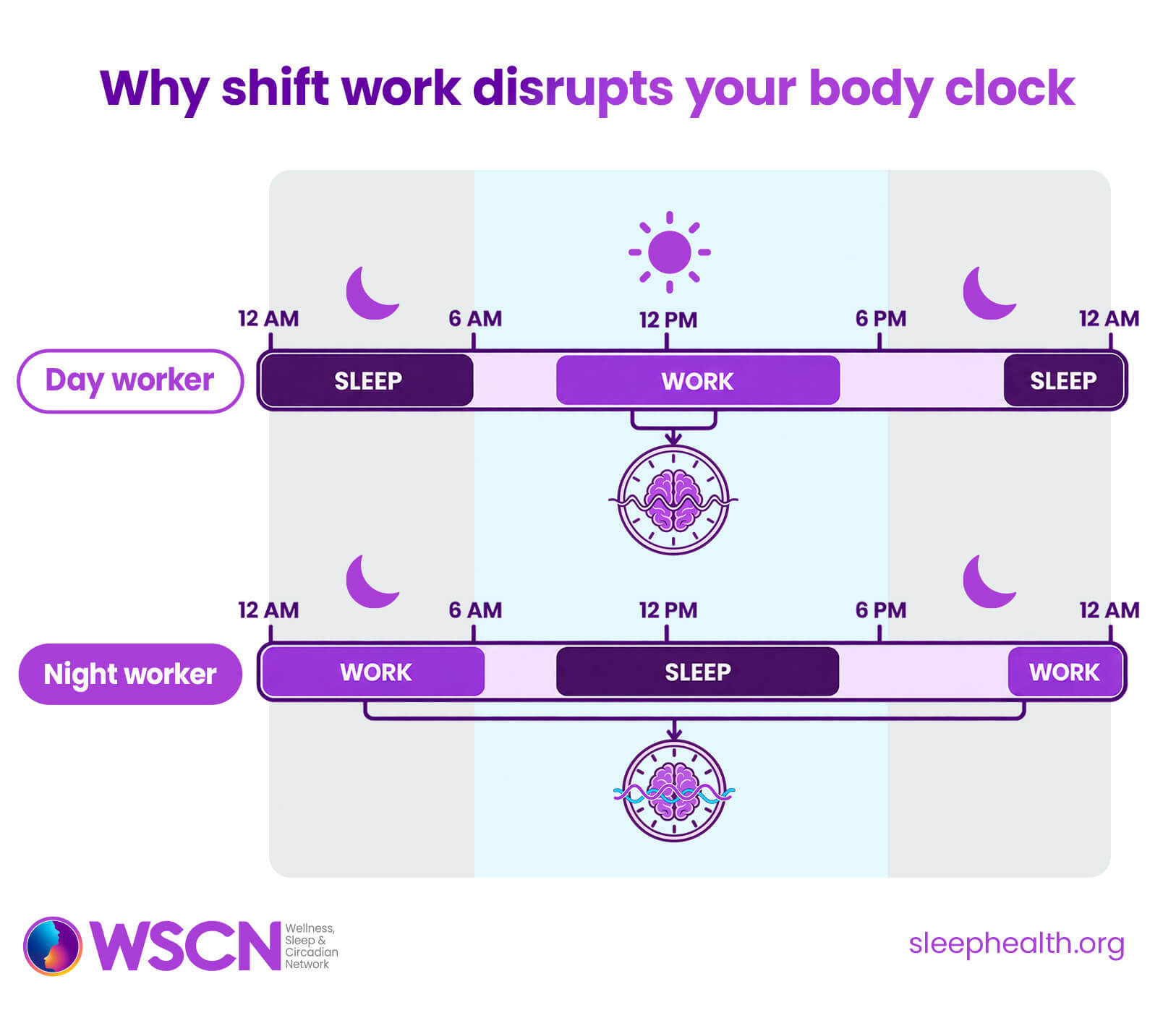
As the graphic above shows, shift work can create a mismatch between working hours and the body’s natural sleep-wake rhythm. This can make it difficult to stay alert at work and get enough sleep afterward.

However, not everyone who works shifts develops a sleep disorder. Shift work disorder occurs when a work schedule repeatedly interferes with sleep, causing persistent insomnia, excessive sleepiness, or both. These symptoms must significantly affect daily life and cannot be better explained by another condition.

Signs and Symptoms

Symptoms of shift work disorder differ from person to person, and they can change with the schedule, the season, and life circumstances.

During the sleep period, a person may notice:

  • Difficulty falling asleep after a shift
  • Waking after only a few hours and being unable to return to sleep
  • Sleep that feels light or unrefreshing
  • Shorter total sleep than the person needs
  • Waking to daylight, household noise, or notifications

Daytime sleep after a night shift is often shorter and more disrupted than nighttime sleep. This can make it difficult for shift workers to get enough rest across the full 24 hours.

During waking hours, a person may notice:

  • Strong sleepiness during the shift, often worst in the early morning hours
  • Difficulty with attention, memory, and decision-making
  • Irritability, low mood, or reduced motivation
  • Headaches, digestive discomfort, or reduced appetite regulation
  • Microsleeps or drowsiness while driving home
  • Reduced energy for family, exercise, and social life on days off

Shift workers may experience sleepiness, fatigue, or both. Sleepiness means struggling to stay awake, while fatigue refers to low energy without necessarily feeling sleepy.

Symptoms often improve during time off and return when shift work resumes. This pattern can help healthcare professionals identify whether the work schedule is contributing to sleep problems.

The 24-Hour Connection: Beyond Sleep

Shift work affects more than when we sleep. Our circadian rhythms also help regulate important functions throughout the body, including blood pressure, metabolism, and hormone release.

When work schedules repeatedly conflict with these rhythms, the effects can extend beyond tiredness and disrupted sleep. Research has linked long-term night and rotating shift work with an increased risk of cardiovascular disease and metabolic conditions, including type 2 diabetes.

Shift work can also affect mental wellbeing and everyday life. Ongoing sleep disruption can make it harder to manage stress, maintain relationships, and participate in family or social activities.

These findings do not mean that everyone who works shifts will develop health problems. However, they show why sleep and circadian health deserve attention as part of a shift worker’s overall health and wellbeing.

Drowsy Driving

Driving home after a night shift can be particularly dangerous because of fatigue and reduced alertness. The risk is especially high after long shifts or when a person has had too little sleep.

If you feel sleepy while driving, stop somewhere safe. Consider taking a nap before leaving work, arranging a ride, or using public transportation. Opening a window or relying on caffeine is not a substitute for adequate sleep.

Screening and Diagnosis

Shift work disorder is diagnosed by reviewing sleep patterns, symptoms, and work schedules. A healthcare professional may recommend keeping a sleep diary for one to two weeks, including workdays and days off. Wearable sleep tracking or questionnaires may also help identify patterns.

An overnight sleep study is usually not needed unless another sleep disorder, such as sleep apnea, is suspected.

Talk with a healthcare professional if sleep difficulties persist or affect your daily life. Seek prompt help if excessive sleepiness makes driving or working unsafe. A primary care clinician is a good place to start. They can conduct preliminary screenings and recommend next steps for diagnosis. To prepare, try using WSCN’s Preparing to meet your new healthcare provider checklist.

Causes and Risk Factors

Not everyone responds to shift work in the same way. Several factors influence how well a person manages irregular work hours.

  • Individual factors: Age, natural sleep preferences (chronotype), and existing health conditions can affect tolerance for shift work.
  • Work schedules: Frequent night shifts, rotating schedules, long shifts, and short breaks between shifts can increase sleep disruption.
  • Sleep environment and daily demands: Noise, daylight, caregiving responsibilities, and limited time for rest can make it harder to get sufficient sleep.

Understanding these factors can help identify opportunities to improve sleep and reduce the effects of shift work.

Treatment and Management

Managing shift work disorder involves improving sleep, staying alert during work hours, and reducing health and safety risks. The best approach depends on your work schedule and individual needs.

  • Protecting sleep: Keep your sleeping environment dark, cool, and quiet. Limit interruptions and try to protect enough time for sleep, even when it falls during the day.
  • Planned sleep and napping: Taking a nap before a night shift or during a permitted break can improve alertness. Some workers benefit from dividing their sleep into two periods.
  • Timed light exposure: Bright light during a shift can improve alertness, while limiting morning light exposure may help with daytime sleep. Timing is important, so seek professional guidance when using light to adjust your body clock.
  • Melatonin: Melatonin can help some shift workers adjust their sleep timing. The timing and dose matter, so discuss its use with a healthcare professional.
  • Strategic caffeine use: Caffeine can improve alertness during a shift, but taking it too close to bedtime can interfere with sleep.
  • Prescription medications: Wake-promoting medications, such as modafinil, may help some people with shift work disorder. Sleep medications may also be considered in selected cases. Both require medical guidance.
  • Treating other conditions: Sleep apnea, insomnia, or other health conditions can make shift work more difficult. Identifying and treating these conditions can improve sleep and daytime functioning.
  • Workplace and schedule adjustments: More predictable schedules, adequate breaks between shifts, and opportunities to rest can reduce sleep disruption. Employers also play an important role in creating safer working conditions.

There is no perfect schedule or single solution that works for everyone. Finding realistic ways to protect sleep and support alertness can help shift workers improve their wellbeing across all 24 hours.

Research and What We Are Still Learning

Researchers continue to investigate why some people adapt to shift work more easily than others. They are studying how individual body clocks and biological differences influence sleep and alertness during irregular work schedules.

Another focus is finding safer ways to organize shift work. Researchers are exploring how changes to shift schedules, planned naps, and carefully timed light exposure can improve sleep and reduce fatigue.

Scientists are also studying the long-term health effects of shift work, including how disrupted circadian rhythms may affect cardiovascular and metabolic health. This research could help develop better strategies to protect shift workers’ health and quality of life.

References

Barger, L. K., Cade, B. E., Ayas, N. T., et al. (2005). Extended work shifts and the risk of motor vehicle crashes among interns. New England Journal of Medicine, 352(2), 125–134. https://doi.org/10.1056/NEJMoa041401

Boivin, D. B., Boudreau, P., & Kosmadopoulos, A. (2022). Disturbance of the circadian system in shift work and its health impact. Journal of Biological Rhythms, 37(1), 3–28. https://doi.org/10.1177/07487304211064218

Drake, C. L., Roehrs, T., Richardson, G., et al. (2004). Shift work sleep disorder: Prevalence and consequences beyond that of symptomatic day workers. Sleep, 27(8), 1453–1462. https://doi.org/10.1093/sleep/27.8.1453

Morgenthaler, T. I., Lee-Chiong, T., Alessi, C., et al. (2007). Practice parameters for the clinical evaluation and treatment of circadian rhythm sleep disorders. Sleep, 30(11), 1445–1459. https://doi.org/10.1093/sleep/30.11.1445

Scheer, F. A. J. L., Hilton, M. F., Mantzoros, C. S., & Shea, S. A. (2009). Adverse metabolic and cardiovascular consequences of circadian misalignment. Proceedings of the National Academy of Sciences, 106(11), 4453–4458. https://doi.org/10.1073/pnas.0808180106

Schweitzer, P. K., Randazzo, A. C., Stone, K., et al. (2006). Laboratory and field studies of naps and caffeine as practical countermeasures for sleep-wake problems associated with night work. Sleep, 29(1), 39–50. https://doi.org/10.1093/sleep/29.1.39

Vetter, C., Devore, E. E., Wegrzyn, L. R., et al. (2016). Association between rotating night shift work and risk of coronary heart disease among women. JAMA, 315(16), 1726–1734. https://doi.org/10.1001/jama.2016.4454

Yong, L. C., Li, J., & Calvert, G. M. (2017). Sleep-related problems in the US working population: Prevalence and association with shiftwork status. Occupational and Environmental Medicine, 74(2), 93–104. https://doi.org/10.1136/oemed-2016-103638


Medical disclaimer
This article is for educational purposes only and is not intended to replace professional medical advice, diagnosis, or treatment. Speak with a qualified healthcare professional about questions or concerns related to your sleep. Read full medical disclaimer