
Kerly’s story: Sleepiness is only the tip of the iceberg

Why the Hidden Symptoms Matter. An Interview with Kerly Bwoga, WSCN Patient Advocate at SLEEP 2026.

When Kerly first started falling asleep in class, nobody understood what was happening. At 15 years old, Kerly was athletic, socially settled, and doing well in school. Then something shifted.

“I was 15 years old… and then I just started sleeping in a lot of my classes,” Kerly explains. Her teachers made assumptions: Kerly was simply a disengaged student. For Kerly, it was especially frustrating because she’d worked hard to change how teachers perceived her, after being known as a cheeky student in early high school. “I started falling asleep and now teachers were complaining about something else.”

At first, Kerly tried to push through. “If I fell asleep in class, I fell asleep… I would just wake up and just get on with the rest of the lesson.” But it wasn’t only happening in classrooms. Kerly started falling asleep while doing homework, and missing her chores. Her family searched for explanations that would make sense in everyday terms – a heavy study load or a long tiring walk from school, anything but a neurological sleep disorder. 

A diagnosis journey shaped by misinterpretation

Kerly’s path to diagnosis wasn’t a straight line. Like so many people with narcolepsy, she was misread by systems that weren’t seeing the whole picture.

The first label was anaemia. Doctors tested Kerly and prescribed iron tablets. Later, when Kerly began experiencing episodes of sudden muscle weakness (what she now recognizes as cataplexy) those moments were interpreted as anxiety. Without the right language, Kerly’s symptoms became something else entirely in medical notes and school conversations.

Kerly described how laughter could trigger a collapse. Friends had to catch her. Teachers were alerted, and eventually a letter went to the school advising students to stop startling Kerly because she was having “panic attacks.”

Later on her diagnostic journey, Kerly would look back and understand that these panic attacks were something else entirely: she was experiencing narcolepsy with  cataplexy. 

After finishing high school the excessive sleepiness intensified. By college, Kerly’s symptoms escalated dramatically. She was falling asleep on public transport, sleeping through classes, and drowning in course reading. Exams became impossible. “Five or ten minutes into the exam, I was completely out… sleeping.”

When doctors couldn’t connect the dots, Kerly and her family were directed toward psychology “because people thought it was in my head”. But that route didn’t bring answers—it brought distress. Kerly recalls her mum becoming fed up when the questioning drifted into assumptions unrelated to Kerly’s sleep problems. 

The turning point: a newspaper article that changed everything

The moment clarity arrived, it came from somewhere unexpected: a school teacher.

“My math teacher’s husband found an article in the newspaper and she then gave it to me,” Kerly said. The article was about a teacher with narcolepsy who experienced loss of muscle control—cataplexy— in the classroom and lost her job as a result. The  description of cataplexy triggered recognition for Kerly. “Those words… the way that they described the loss of muscle control, I was like, that is it, that’s me.”

Kerly took the article to a doctor. Within a month, she had an appointment with a sleep specialist, who asked Kerly to describe what troubled her most.

Kerly told him she was falling asleep in class and experiencing muscle collapse when she laughed.

Within 5 minutes, Kerly had an explanation, and a name – Narcolepsy. After years of confusion, it was surreal. “It was weird… How does he know this? We haven’t spoken to him for five minutes. And this has been three years and no one said anything to us.”

The specialist called it “textbook narcolepsy.” Formal testing came later, but the most important moment of recognition arrived in a single conversation where the right clinician heard the right details and was able to join the dots for Kerly.

The Iceberg: what people don’t see

Kerly’s narcolepsy iceberg graphics (below) capture a truth many people living with narcolepsy and other hypersomnolence disorders understand immediately: the symptoms that get named and measured are often only the tip of their lived experience.

Narcolepsy is typically associated with five key symptoms*:

  1. Excessive daytime sleepiness
  2. Cataplexy
  3. Sleep paralysis
  4. Hypnagogic/hypnopompic hallucinations
  5. Disrupted nighttime sleep

*Not all people with narcolepsy experience these symptoms
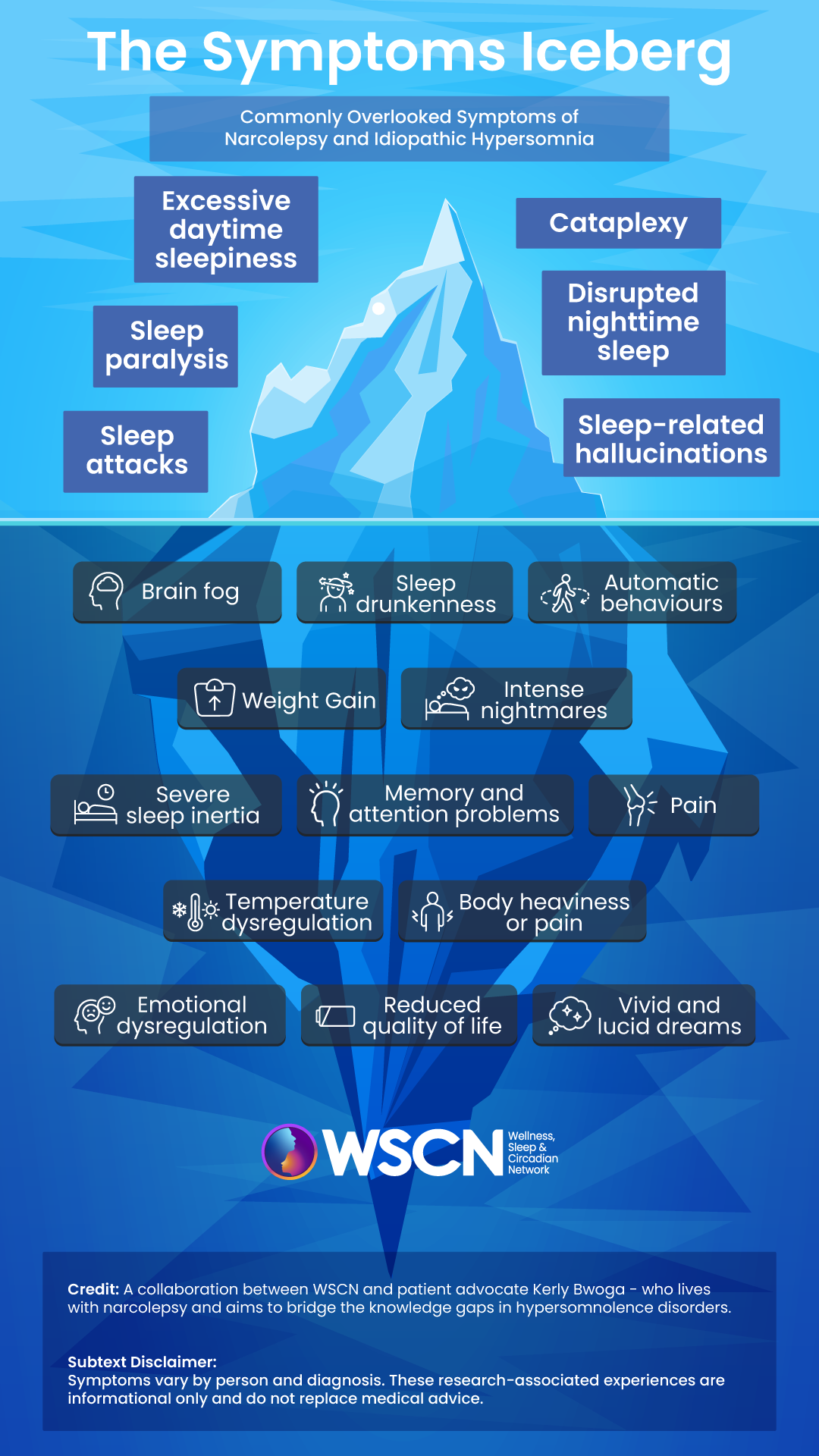
Kerly emphasizes that many other symptoms are often ignored, misunderstood, or never discussed. In her graphic they sit below the waterline – the hidden parts of the iceberg.

For Kerly, the nightmares were profound early on. “The intense nightmares… we didn’t realise at the time that they were connected.” In Kerly’s Christian family, those nightmares were interpreted through a spiritual lens. “My parents were like praying over me because they thought that it was like some type of spiritual warfare.”

Weight gain was another hidden burden. “I started to gain weight… we attributed it to the [contraceptive] pill.” Only later did Kerly learn about the disorder’s connection to obesity. “It wasn’t until my 30s that I actually realised that narcolepsy had a connection to obesity at all.”

Then there’s temperature dysregulation: being freezing in winter, overheated in summer—again, not obviously “narcolepsy” unless someone is taught to see the whole pattern. Kerly later connected this to altered hypothalamic function in the brain that occurs due to disruptions in the signalling neuropeptide Orexin, which occurs in narcolepsy type 1. The result is that many people living with narcolepsy have difficulty regulating their core temperature appropriate for the time of day, and as a result often feel too hot or cold.

Kerly also spoke about narcolepsy pain—a symptom that emerged for her in the last five years and was initially feared to be fibromyalgia. Over time, Kerly found community evidence in online groups, then clinical confirmation. “Other people were saying that they were also having pain… and the only thing that connected us is narcolepsy.” Eventually: “I asked my expert sleep consultant about it and then she confirmed it to me.” It is thought that narcolepsy pain, similar to temperature dysregulation, stems from altered brain signalling and sensory processing. This can then be amplified by stress, sleep disruption, obesity and depression – all common issues that narcolepsy patients might live with.

Other health conditions – the comorbidities iceberg
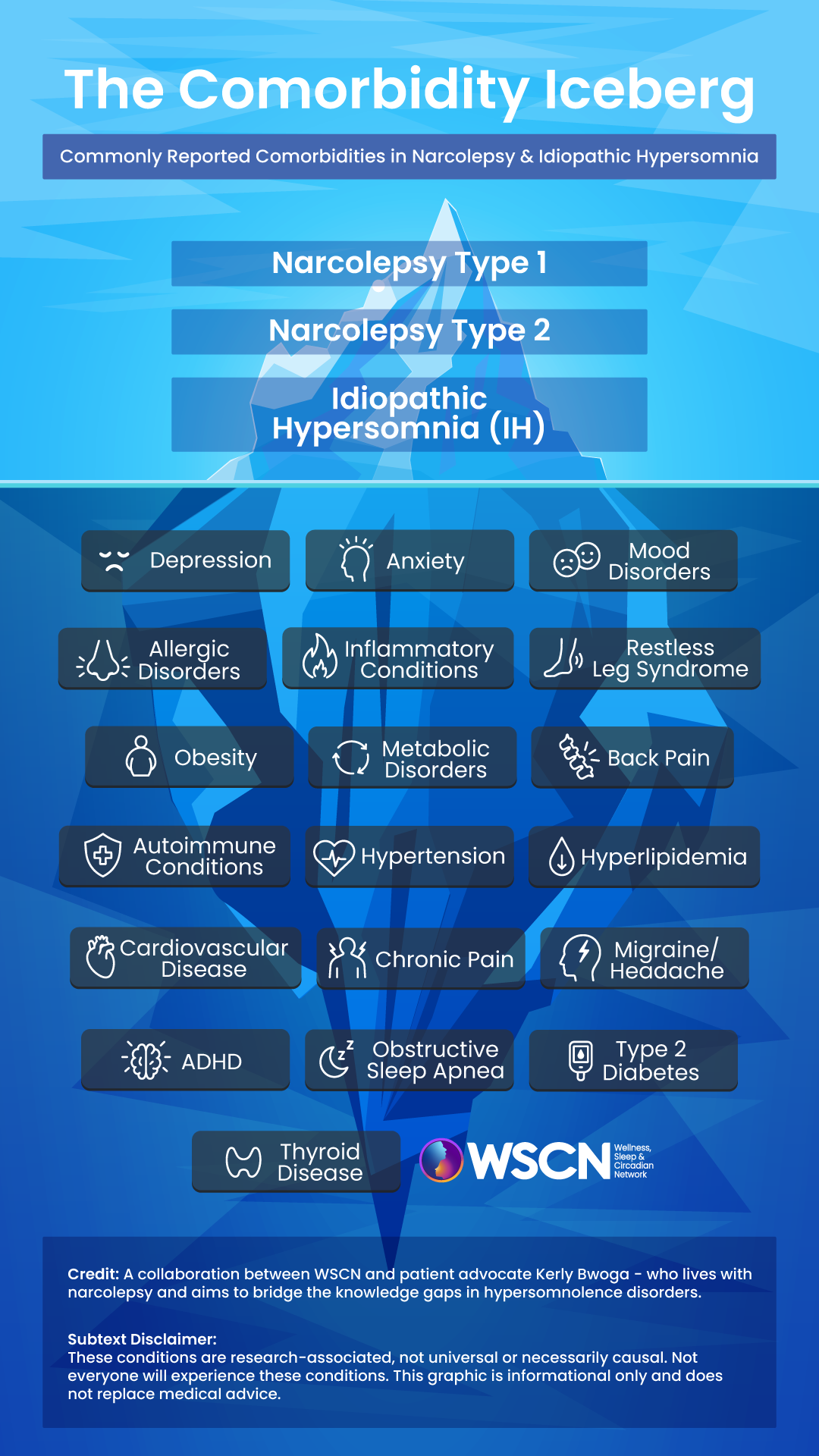
Kerly describes other health conditions that she lives with. In her advocacy work, and after doing her own research, Kerly was inspired to create a second Iceberg graphic – this time to demonstrate how people with narcolepsy can be living with other health problems, which adds to the burden of disease. By creating and sharing these graphics Kerly hopes to increase awareness and understanding of narcolepsy.

Why do we miss symptoms, and how can storytelling help?

Kerly doesn’t blame individual clinicians; Kerly points to training and time deficits. “At [medical] school, they’re just teaching them about the five typical symptoms of narcolepsy, so that is what they’re focusing on.” And appointments are short: doctors “don’t have long enough to talk to each patient… they’re not asking the right questions.”

The result is predictable: patients don’t mention what feels embarrassing, irrelevant, or hard to articulate. And many symptoms carry cultural stigma. That’s why Kerly believes that real patient stories matter. It was because Kerly found herself mirrored in the story of the cataplectic school teacher, and was able to share this with her doctor, that her diagnosis journey shifted in the right direction.

From personal experience to patient advocacy

For Kerly, inspiration came from the gaps in her own narcolepsy journey. Initially it was the lack of educational resources and social isolation of having a rare disease. There was nobody she could connect with.  So, Kerly began organically with online Facebook groups, where she supported others navigating similar challenges. She later connected with Narcolepsy UK, where she volunteered in awareness raising and engagement activities. During the COVID-19 pandemic, Kerly hosted online support meetings, ensuring continued connection and support for the community. 

​This growing passion led to the founding of NapsForLife, a nonprofit organisation dedicated to empowering individuals affected by central disorders of hypersomnia through education, storytelling, and peer support. The organisation works to raise public awareness and improve understanding across healthcare, employment, and wider society. One of its key projects is the Narcolepsy Navigators Podcast, in which Kerly and her guests share real-life stories with the global audience.

Kerly’s guiding belief is simple and deeply human: someone out there needs to hear your story. It is this sharing that allows people to see themselves mirrored, and find the words to explain their own unique experiences. This builds the foundations for better communication with doctors, teachers, employers, friends and family.

Kerly’s advice for patients: make it concrete

When it comes to being heard by clinicians, Kerly’s advice is practical:

  • “Write everything down before you go.”
  • Focus on quality of life. Describe what you used to be able to do, but no longer can due to your symptoms. Explain your functional limitations.
  • Avoid vague words like “tired” – instead use words like excessive sleepiness
  • Use examples, plain language, and “Film things… that is so powerful.”
  • Explain all your health concerns – there could be connected symptoms

And finally, Kerly wants to remind people that narcolepsy isn’t a static set of experiences. “Narcolepsy works in waves… it changes.” Different people experience different symptoms across their lifetime, and there is no one-size-fits-all.

Kerly’s story is a powerful example of what happens when people can connect with each other, learn together and support one another. By turning her own journey into advocacy work, Kerly is doing more than telling a story – Kerly is helping other people finally recognize themselves in it, so that they can change their own narrative.