Sleep & Circadian Health
Neurobiology of Circadian Rhythms
How the brain controls sleep and wakefulness: hormones, neuropeptides, and neurotransmitters
Sleep and wakefulness are not controlled by tiredness alone. They are coordinated by the brain’s master clock, the gradual buildup of sleep pressure, and a network of chemical messengers working together across all 24 hours.
Understanding how these systems work can help us better understand our own sleep and circadian health. It can also help us make sense of new research and have more informed conversations with healthcare professionals.
Overview
- Two systems work together to regulate sleep and wakefulness: the body’s internal clock and sleep pressure, which builds the longer we stay awake.
- Our internal clock runs slightly longer than 24 hours and is reset each day, mainly by exposure to light.
- Hormones such as melatonin and cortisol follow daily rhythms that help regulate sleep, alertness, and other body functions.
- Neurotransmitters are chemical messengers that help the brain switch between sleep and wakefulness.
- Orexin, a neuropeptide, helps maintain wakefulness and keeps the sleep-wake system stable. Loss of orexin-producing cells causes type 1 narcolepsy.
- Adenosine builds up during waking hours and contributes to sleep pressure. Caffeine temporarily reduces sleepiness by blocking its effects.
- Sleep and circadian rhythms also influence hormones involved in appetite, metabolism, and blood sugar regulation.
ON THIS PAGE
-
How do the body clock and sleep pressure work together?
-
Why does the body clock need to reset each day?
-
How do sleep and the body clock affect hormones?
-
What neurotransmitters control sleep and wakefulness?
-
How does the brain switch between sleep and wakefulness?
-
What happens when this balance is disrupted?
How do the body clock and sleep pressure work together?
Two systems work together to regulate sleep. The first is sleep pressure, also called the homeostatic sleep drive or Process S. It builds the longer we stay awake and decreases during sleep.
The second is the circadian rhythm, or Process C, which is controlled by the brain’s master clock, called the suprachiasmatic nucleus (SCN).
During the day, the circadian system sends signals that help us stay alert, even as sleep pressure increases. In the evening, these alerting signals weaken and melatonin levels begin to rise, making it easier to fall asleep. This creates a window sometimes called the “sleep gate.”
Although these two systems were traditionally studied separately, research shows that they influence each other. Together, they help determine when we feel awake and when we’re ready for sleep.
Read more about Process S and Process C here.
Why does the body clock need to reset each day?
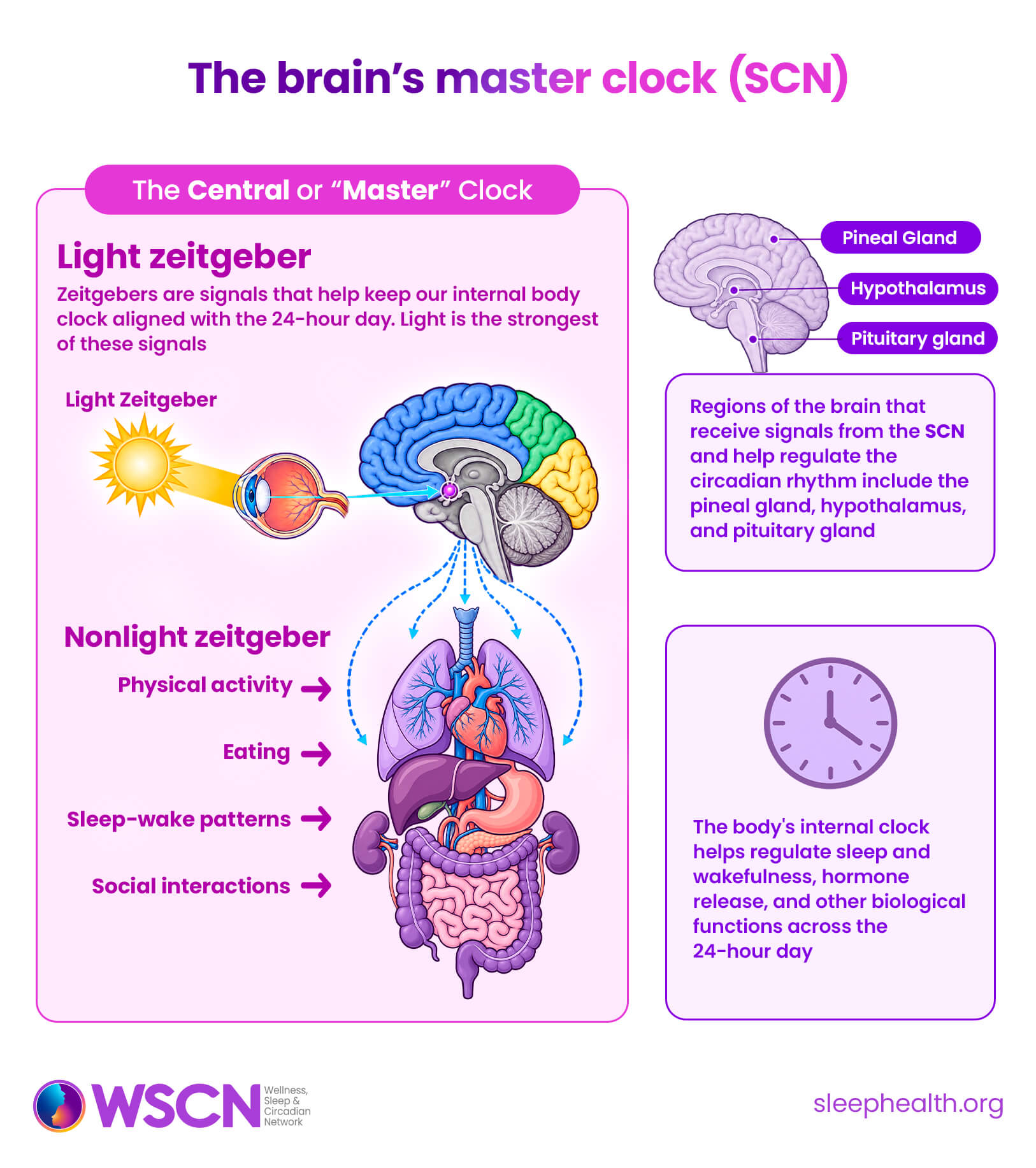
Our internal body clock runs slightly longer than 24 hours, by about 11–18 minutes on average. Without daily adjustments, our natural sleep and wake times would gradually shift later, moving out of sync with the day-night cycle.
Light is the strongest signal that keeps our body clock aligned with the 24-hour day. Scientists call these signals zeitgebers, or “time-givers.” Morning light helps reset the brain’s master clock, the suprachiasmatic nucleus (SCN), while bright light in the evening can shift our body clock later, making it harder to fall asleep at the usual time.
The importance of light was demonstrated in a study comparing people who spent a weekend camping outdoors with those who stayed at home. Exposure to natural daylight and darkness shifted the campers’ internal clocks earlier, while those exposed to electric lighting experienced a later shift.
How do sleep and the body clock affect hormones?
Hormones are chemical messengers that regulate many functions in the body. Many follow daily rhythms influenced by sleep and the body’s internal clock, and these patterns can change when sleep is disrupted or poorly timed.
Melatonin
Melatonin is made by the pineal gland in the brain. Levels rise in the evening as darkness signals “biological night” and stay elevated overnight. Melatonin signals biological night and helps prepare for sleep, but it does not act like a conventional sleeping pill. Evening light exposure, even at ordinary indoor and screen levels, can suppress melatonin and delay its release, leading to delayed onset of sleep. Sensitivity to evening light varies widely between people. Read more about melatonin and supplementation.
Cortisol
Cortisol is often called a stress hormone, but it also helps the body wake up and mobilizes energy to support daily activities. Levels normally peak shortly after waking and fall to their lowest point in the first part of the night. Sleep loss, as well as stress, can raise cortisol in the evening, when it should be low. This can both delay the onset of sleep and disrupt sleep across the night, often leading to the dreaded 3am wake-up. Ongoing circadian disruption, such as long-term night-shift work, can flatten, shift, or even reverse the normal daily pattern.
Leptin and ghrelin
Leptin and ghrelin are hormones that help regulate hunger and appetite. Leptin, produced mainly by fat tissue, helps signal the body’s energy stores and reduce hunger. Ghrelin, produced mainly by the stomach, stimulates hunger.
Sleep and circadian rhythms influence how these hormones are regulated. Some studies have found that insufficient sleep increases ghrelin or reduces leptin, although results are not consistent across studies.
Research also shows that insufficient sleep can increase hunger and food intake, which may contribute to weight gain over time. Changes in appetite hormones may play a role, but they are only part of this complex relationship.
Thyroid-stimulating hormone (TSH)
TSH is released by the pituitary gland and it stimulates the thyroid to produce its own hormones that regulate metabolism and energy. TSH normally rises in the evening and peaks around the start of sleep. Deep sleep then helps hold TSH levels down. Disrupted sleep can alter how and when TSH is released, which in turn impacts metabolic patterns.
Insulin
Insulin helps move sugar (glucose) from the blood into cells for energy. Insufficient sleep can make the body less responsive to insulin, a state called reduced insulin sensitivity. Eating when the body clock expects sleep can also impair blood sugar control. Over time, these changes are associated with a higher risk of type 2 diabetes. In a simulated night-shift study, eating at night reduced glucose tolerance, while limiting meals to daytime hours prevented this effect.
These findings suggest that when we eat, as well as when we sleep, can influence blood sugar regulation. They also highlight the importance of circadian timing for metabolic health.
What neurotransmitters control sleep and wakefulness?
Neurotransmitters are chemical messengers that carry signals between nerve cells. Some help keep us awake and alert, while others promote sleep. Different areas of the brain release these messengers to help regulate the sleep-wake cycle.
- Norepinephrine: Released mainly from an area of the brainstem called the locus coeruleus. It helps maintain alertness and attention and is closely related to adrenaline, a hormone involved in the stress response.
- Dopamine: Produced in several brain regions, including the midbrain. It helps promote wakefulness and plays an important role in motivation and reward.
- Serotonin: Released from areas of the brainstem called the raphe nuclei. It helps regulate wakefulness and mood, although its effects on sleep vary depending on where and how it acts in the brain.
- Histamine: Released from an area of the hypothalamus, histamine helps maintain wakefulness. This explains why some antihistamine medications cause drowsiness.
- GABA and galanin: Released by sleep-promoting nerve cells in the hypothalamus, these chemical messengers help quiet the brain systems that keep us awake, allowing sleep to begin.
Together, these neurotransmitters help the brain regulate when we are awake and when we sleep.
Adenosine and caffeine
Adenosine is a neuromodulator, a chemical that adjusts how strongly other brain signals act. It builds up in the brain during waking hours as brain cells use energy, and it is one of the main signals behind sleep pressure. During sleep, adenosine levels fall and sleep pressure resets.
Caffeine blocks adenosine from attaching to its receptors. This is why caffeine can temporarily reduce feelings of sleepiness, even though the body’s need for sleep remains and adenosine continues to build up over the day. Because caffeine can stay active for many hours, intake later in the day can make it harder to fall asleep and can make sleep lighter. Research also suggests that high levels of daily caffeine intake can delay REM sleep and lower sleep quality.
Orexin (hypocretin)
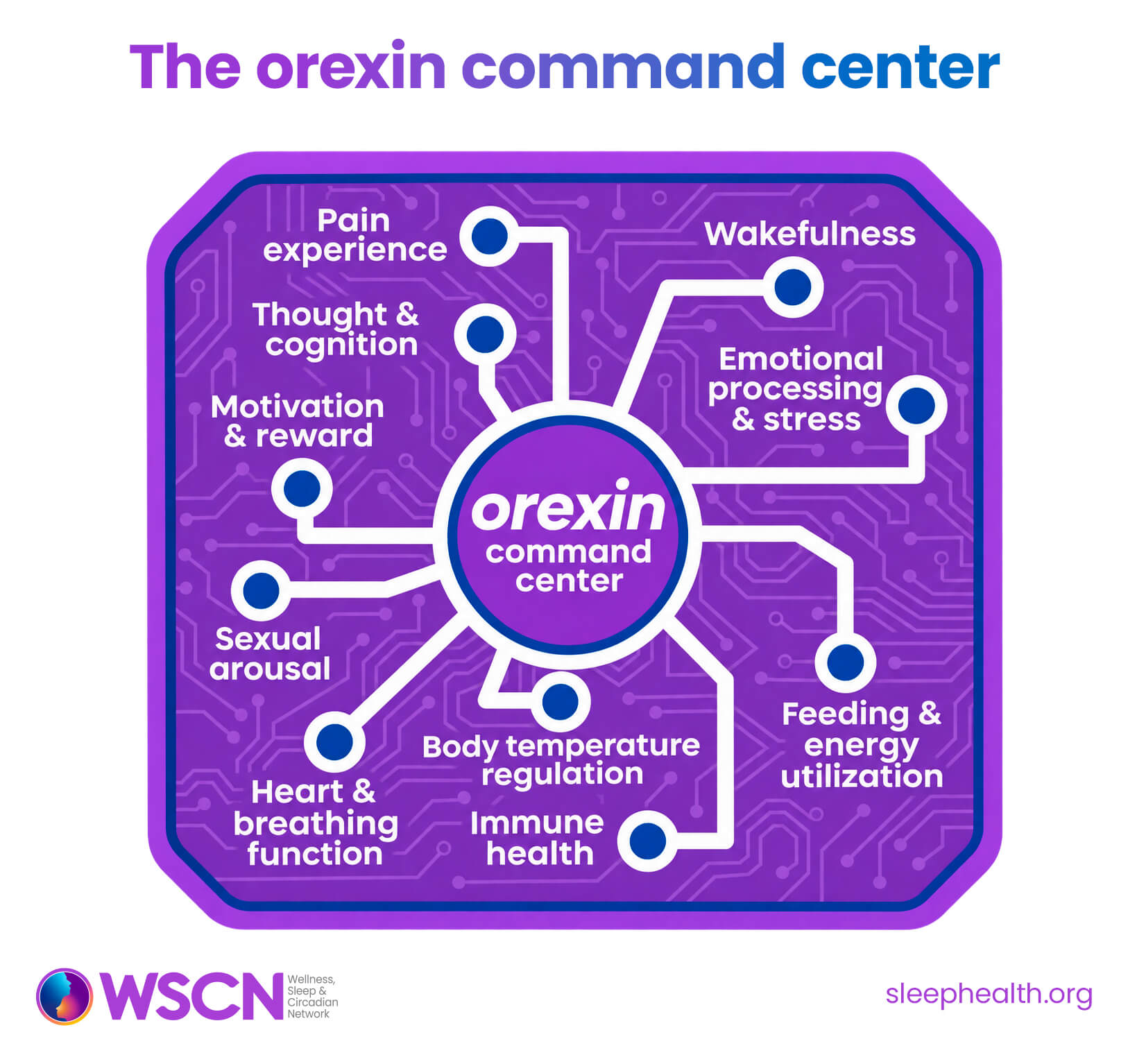
Orexin, also called hypocretin, is a neuropeptide produced by a small group of nerve cells in the hypothalamus. It helps maintain wakefulness by activating several of the brain systems that keep us awake and alert.
Orexin also helps stabilize the transition between sleep and wakefulness, preventing sudden changes between these states. It plays an important role in regulating REM sleep and is involved in other functions, including appetite and energy regulation.
In people with type 1 narcolepsy, most orexin-producing nerve cells have been lost. Without enough orexin, the brain has difficulty maintaining stable sleep and wakefulness. This can lead to excessive daytime sleepiness, sudden episodes of sleep, and symptoms such as cataplexy, a sudden loss of muscle control triggered by strong emotions. Learn more about narcolepsy here.
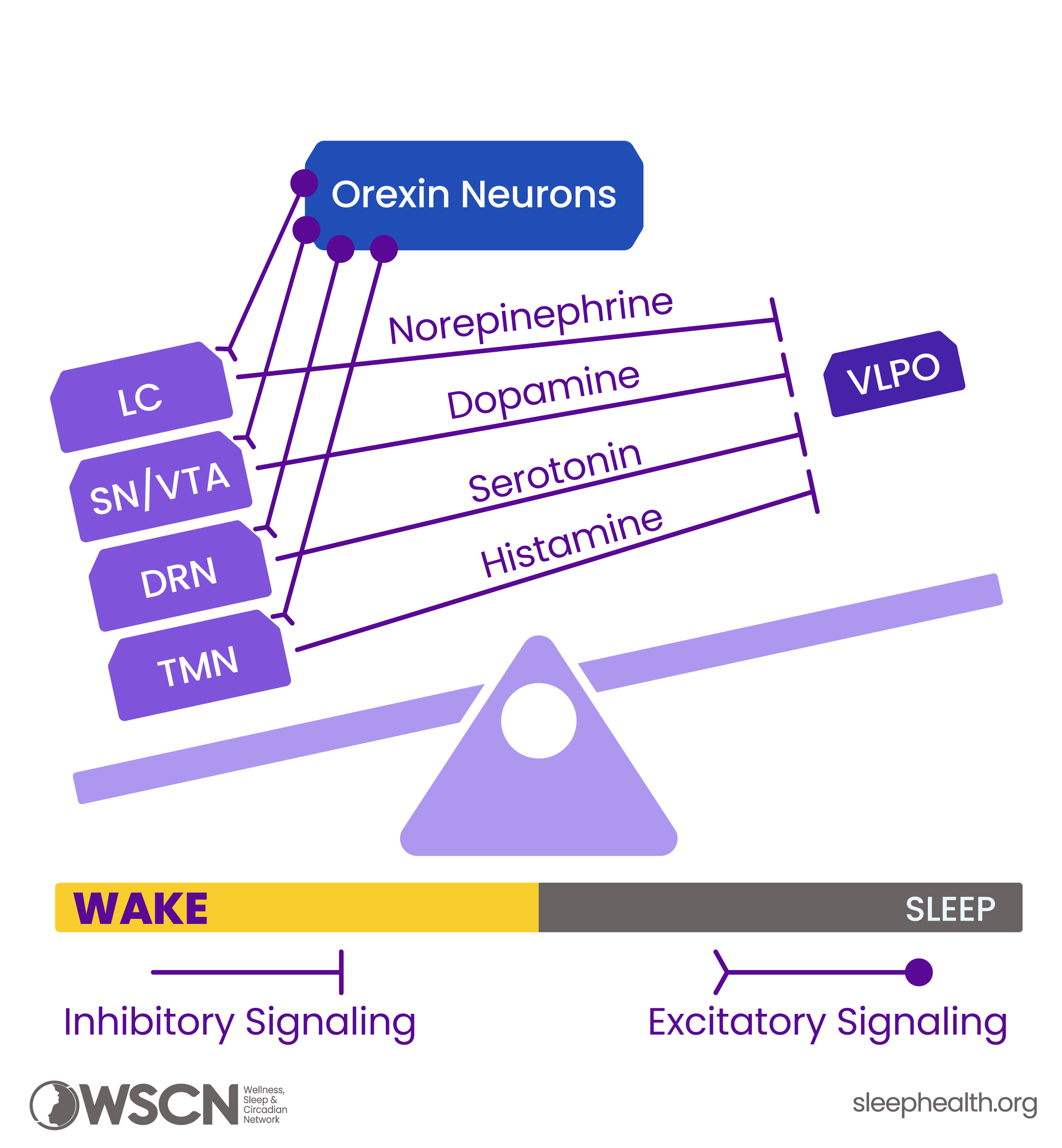
How does the brain switch between sleep and wakefulness?
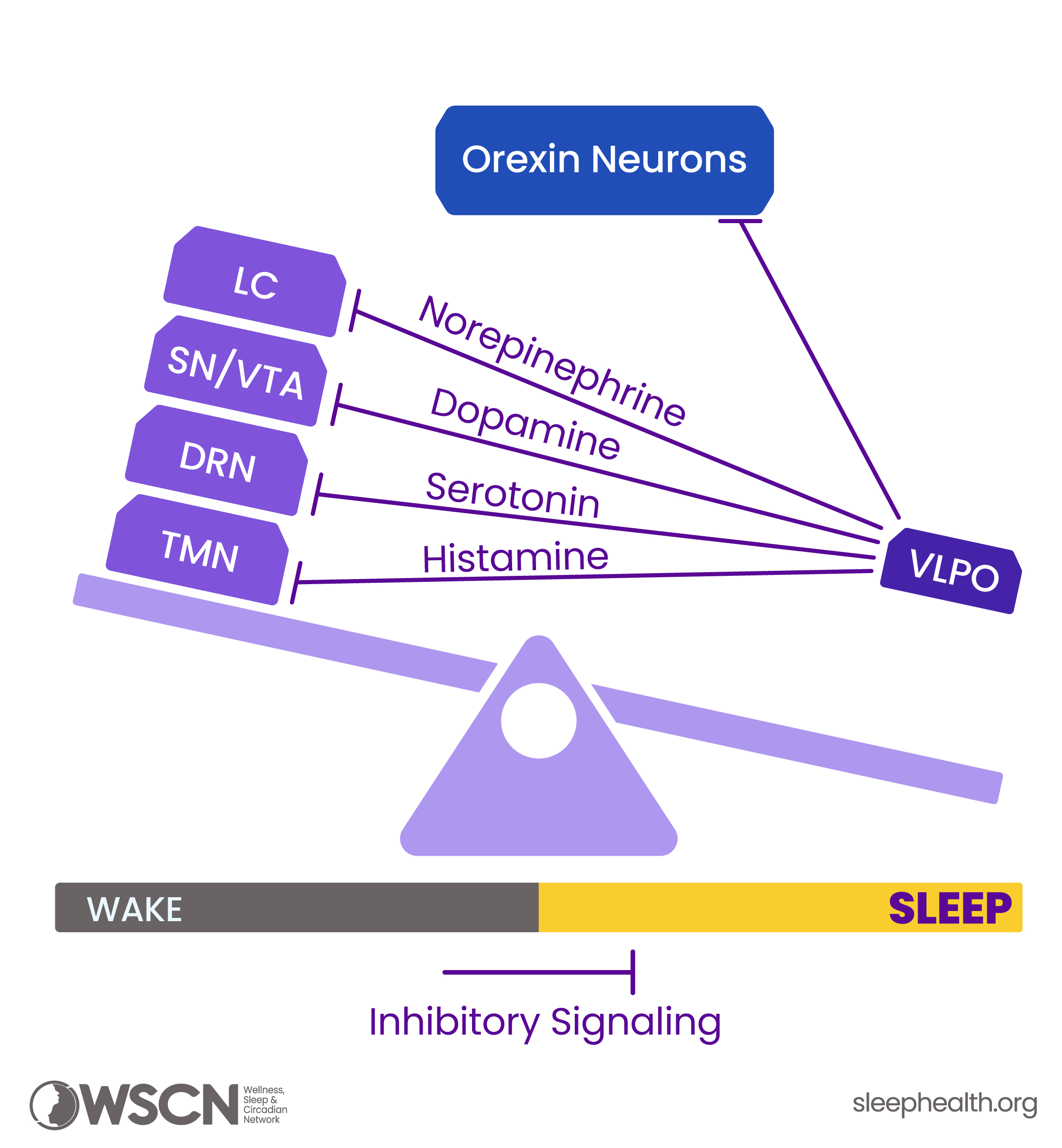
The brain has a system that helps us move between sleep and wakefulness, often described as a “flip-flop switch.” Like a light switch, it helps the brain shift between two distinct states rather than remaining somewhere in between.
When sleep-promoting nerve cells in the hypothalamus become active, they suppress the brain systems that keep us awake. When wake-promoting systems are active, they suppress the sleep-promoting cells, helping us stay alert.
Orexin helps stabilize this switch, keeping us awake when we need to be and preventing unwanted transitions into sleep. Sleep pressure and the body’s internal clock influence when the switch changes states, helping coordinate sleep and wakefulness with our daily rhythms.
What happens when this balance is disrupted?
Sleep loss, irregular schedules, night-shift work, and jet lag can disrupt the body’s internal clock and the chemical signals that regulate sleep and wakefulness.
These disruptions can affect how we feel and function, contributing to daytime sleepiness, difficulty concentrating, and changes in mood. Over time, ongoing sleep and circadian disruption is also associated with an increased risk of metabolic conditions, including obesity and type 2 diabetes.
The relationship works in both directions. Conditions that affect the brain’s sleep-wake systems, such as narcolepsy, can also interfere with normal sleep and circadian rhythms.
Understanding how these systems work together can help us make more informed choices about sleep and daily routines. Although we cannot always control our schedules, finding opportunities to support regular sleep and circadian rhythms can benefit our overall health.
Broussard, J. L., Kilkus, J. M., Delebecque, F., A, et al. (2016). Elevated ghrelin predicts food intake during experimental sleep restriction. Obesity, 24(1), 132–138. https://doi.org/10.1002/oby.21321
Chellappa, S. L., Qian, J., Vujovic, N., et al. (2021). Daytime eating prevents internal circadian misalignment and glucose intolerance in night work. Science Advances, 7(49), Article eabg9910. https://doi.org/10.1126/sciadv.abg9910
Duffy, J. F., Cain, S. W., Chang, A.-M., et al. (2011). Sex difference in the near-24-hour intrinsic period of the human circadian timing system. Proceedings of the National Academy of Sciences, 108(Suppl. 3), 15602–15608. https://doi.org/10.1073/pnas.1010666108
Morse, A. M. (2025). Enhancing the management of hypersomnia: Examining the role of the orexin system. Seminars in Neurology, 45(3), 410–419. https://doi.org/10.1055/a-2589-3825
Phillips, A. J. K., Vidafar, P., Burns, A. C., et al. (2019). High sensitivity and interindividual variability in the response of the human circadian system to evening light. Proceedings of the National Academy of Sciences, 116(24), 12019–12024. https://doi.org/10.1073/pnas.1901824116
Scammell, T. E., Arrigoni, E., & Lipton, J. O. (2017). Neural circuitry of wakefulness and sleep. Neuron, 93(4), 747–765. https://doi.org/10.1016/j.neuron.2017.01.014
Stothard, E. R., McHill, A. W., Depner, C. M., et al. (2017). Circadian entrainment to the natural light-dark cycle across seasons and the weekend. Current Biology, 27(4), 508–513. https://doi.org/10.1016/j.cub.2016.12.041
Weibel, J., Lin, Y.-S., Landolt, H.-P., et al. (2021). Regular caffeine intake delays REM sleep promotion and attenuates sleep quality in healthy men. Journal of Biological Rhythms, 36(4), 384–394. https://doi.org/10.1177/07487304211013995
This article is for educational purposes only and is not intended to replace professional medical advice, diagnosis, or treatment. Speak with a qualified healthcare professional about questions or concerns related to your sleep. Read full medical disclaimer