
Sleep & Circadian Disorders

Stress

Stress and sleep are closely connected. Stress can keep the mind and body alert when it is time to rest, making it harder to fall asleep or stay asleep. Poor sleep, in turn, can make it more difficult to manage stress and everyday challenges.

This cycle can be difficult to break, but understanding how stress and sleep affect each other is an important first step toward improving both. Small changes and appropriate support can help restore healthier sleep patterns and improve wellbeing across all 24 hours.

Overview

  • Stress can disrupt sleep, making it harder to fall asleep, stay asleep, or feel rested in the morning
  • Poor sleep can increase stress, affecting mood, concentration, and our ability to cope with everyday challenges
  • Short-term sleep difficulties during stressful periods are common, but persistent problems that affect daily life deserve attention
  • Daily habits and routines can help support sleep and reduce the effects of stress, even when stressors cannot be eliminated
  • Professional support can help address ongoing sleep problems, stress, or underlying mental health conditions

How stress affects sleep

Stress is the body’s natural response to challenges or uncertainty. It can be short-term, such as before an important exam, or ongoing because of work pressures, financial concerns, or difficult life circumstances.

When we experience stress, our body becomes more alert. Heart rate and muscle tension may increase, while our minds become more active. This response can help us deal with challenges during the day, but it can also make it harder to relax and fall asleep at night.

Some people are particularly sensitive to the effects of stress on sleep. Even after a stressful situation has passed, they may continue to experience sleep difficulties, especially if worry about sleeping becomes another source of stress.

Signs and symptoms

Stress can affect both how we sleep at night and how we feel and function during the day. The signs vary from person to person and may change depending on the intensity and duration of stress.

Nighttime signs

  • Taking longer than usual to fall asleep
  • Waking often or staying awake after waking
  • Waking earlier than intended
  • Feeling mentally alert, watchful, tense, or unable to “switch off”
  • Replaying events, planning, or worrying before sleep or during awakenings
  • Experiencing light, broken, or unrefreshing sleep

Daytime signs

  • Feeling tired, sleepy, irritable, anxious, or emotionally sensitive
  • Having difficulty concentrating, remembering, making decisions, or solving problems
  • Feeling less able to cope with routine demands
  • Using more caffeine, alcohol, nicotine, cannabis, or sedating products
  • Napping irregularly, reducing activity, or canceling plans after poor sleep
  • Worrying about the ability to sleep the next night

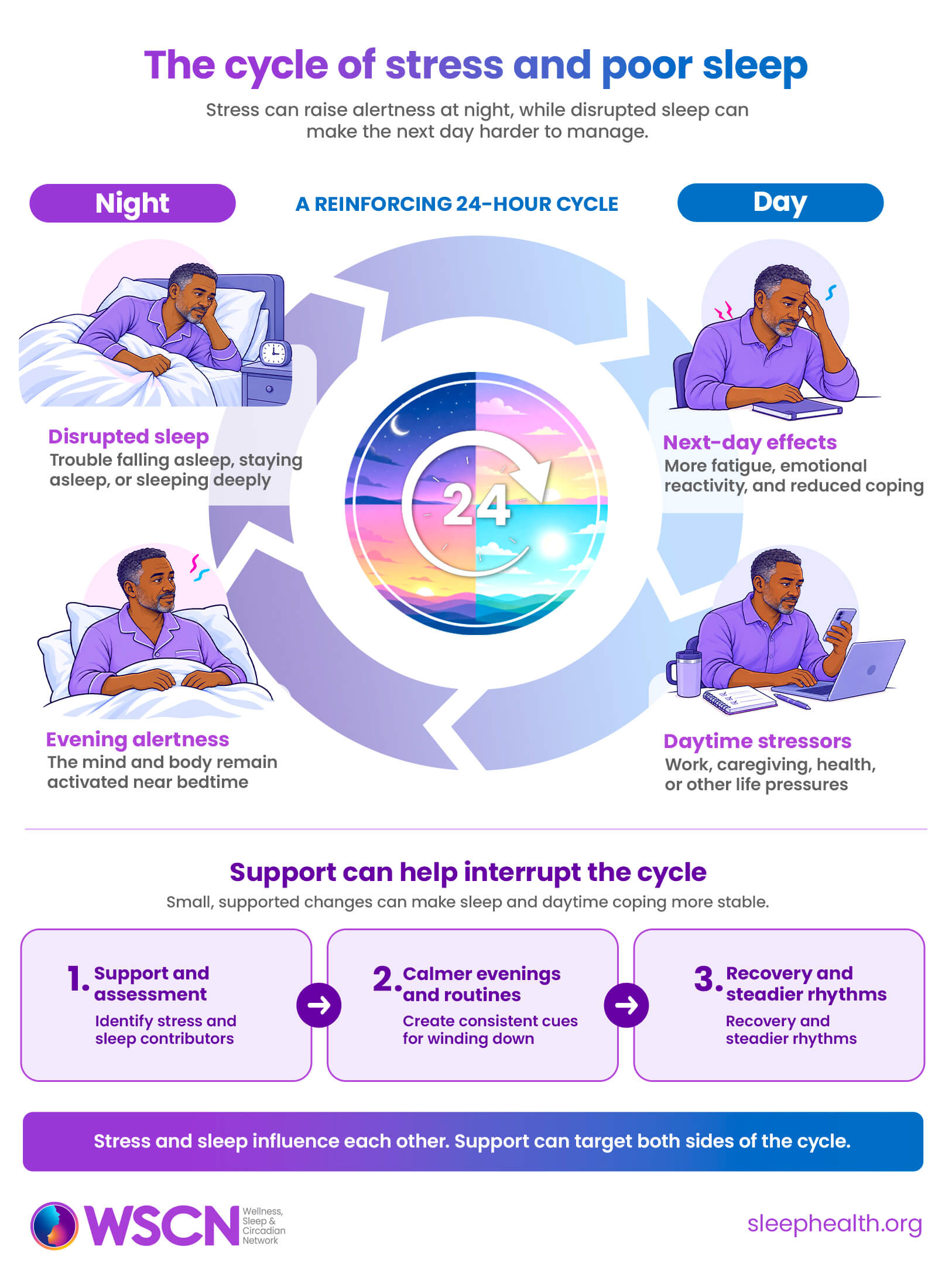
Stress and poor sleep can affect how we feel and function throughout the day. A stressful day can make it harder to unwind, while poor sleep can affect our mood, energy, and ability to cope.

Habits such as drinking more caffeine, taking late naps, or spending extra time in bed can sometimes make sleep problems worse. Irregular schedules and light exposure may also disrupt our natural sleep-wake rhythms.

Breaking this cycle does not mean eliminating every source of stress. Recognizing these patterns can help us make practical changes that support better sleep and wellbeing across all 24 hours.

The graphic below illustrates this cycle.
Screening and diagnosis

There is no single test for stress-related sleep problems. A healthcare professional can help identify how stress may be affecting your sleep and whether other conditions are contributing.

An assessment may include reviewing your sleep patterns, daily routines, and current stressors. A sleep diary kept over one to two weeks can help identify patterns, while questionnaires may provide additional information. If another sleep disorder is suspected, further testing may be recommended.

When to talk with a healthcare professional

A person does not need to know the name or exact nature of a condition before asking for help. If a person experiences any of the symptoms above, it is appropriate to discuss them with a healthcare professional. 

Red Flag: Seek urgent medical care if symptoms or sleep loss are affecting a person’s ability to drive or work safely, or is causing severe distress or thoughts of self-harm.

What to bring to a doctor’s visit

A primary care physician is a good place to start for an evaluation of stress-sleep interactions. They can conduct preliminary screenings and recommend next steps for diagnosis. It can be helpful to bring information to an initial visit: try using WSCN’s Preparing to meet your new healthcare provider checklist.

Causes, risk factors and health implications

Causes and risk factors

Stress affects everyone differently, and several factors can increase the likelihood of experiencing sleep problems.

  • Life circumstances: Ongoing pressures related to work, finances, relationships, caregiving, or health can make restful sleep more difficult.
  • Individual sensitivity: Some people are more likely to experience sleep difficulties during stressful periods, particularly if they have had sleep problems before.
  • Mental and physical health: Conditions such as anxiety, depression, PTSD, chronic pain, or menopause symptoms can affect both stress and sleep.
  • Schedules and environment: Irregular work hours, noise, light, and limited opportunities for sleep can contribute to sleep disruption.
  • Medications and substances: Caffeine, nicotine, alcohol, certain medications, and other substances can interfere with sleep or alertness.

Several of these factors may occur together. Identifying which ones affect your sleep can help you and your healthcare professional find appropriate ways to improve it.

Stress, the autonomic nervous system, and sleep

The autonomic nervous system controls automatic functions such as heart rate and breathing. It has two main branches: the sympathetic nervous system, which helps the body respond to stress, and the parasympathetic nervous system, which supports rest and recovery.

During stressful periods, the body’s alertness response can remain elevated, even when it is time to sleep. A racing heart, muscle tension, or feeling constantly on guard can make it harder to fall asleep or return to sleep after waking.

Relaxation techniques, such as slow breathing or meditation, can help calm this response and support better sleep.

Long-term health implications

Persistent stress and chronic sleep disruption are associated with health risks, although they do not cause the same outcome in every person.

  • Heart health: Ongoing sleep disruption and stress-system activation may contribute to high blood pressure and cardiovascular risk.
  • Metabolic health: Poor sleep may affect glucose regulation, appetite, weight-related health, and the ability to maintain health routines.
  • Mental health: Insomnia and chronic stress may increase the risk or severity of depression, anxiety, PTSD symptoms, and suicidal thinking.
  • Cognition and safety: Reduced attention, memory, reaction time, and judgment may increase errors, injuries, and drowsy-driving risk.
  • Pain and immune function: Sleep disruption may increase pain sensitivity and affect inflammatory and immune processes.
  • Quality of life: The cycle may strain work, relationships, caregiving, social connection, and confidence in sleep.

Chronic stress and sleep loss can both affect short-term and long-term health, and deserve evaluation and treatment to support health and well-being.

Treatment and management

Managing stress-related sleep problems involves addressing sources of stress where possible and finding ways to support better sleep. Different approaches may be helpful depending on individual circumstances.

  • Addressing stressors: Changes to workloads, schedules, or responsibilities can sometimes reduce stress. When these changes are not possible, other coping strategies can help.
  • Relaxation techniques: Slow breathing, muscle relaxation, and mindfulness can help calm the mind and body before sleep.
  • Healthy sleep routines: Consistent sleep and wake times, regular physical activity, and appropriate light exposure can support sleep and circadian rhythms.
  • Cognitive behavioral therapy for insomnia (CBT-I): This is the recommended first-line treatment for chronic insomnia. It helps address habits and thought patterns that contribute to ongoing sleep difficulties.
  • Mental health support: Counseling or other psychological treatments can help manage persistent stress, anxiety, depression, or trauma-related symptoms.
  • Medical assessment and treatment: A healthcare professional can review medications and identify other conditions, such as sleep apnea or chronic pain, that may be contributing to sleep problems.

Improving sleep does not always require major lifestyle changes. Small, realistic adjustments and appropriate support can make a meaningful difference, even during stressful periods.

Research and what we are still learning

Research supports a two-way relationship between stress and sleep, but not everyone responds in the same way. Studies are examining sleep reactivity, the roles of the autonomic nervous system and stress hormones, differences across life stages and social conditions, and which treatments work best when insomnia and mental health symptoms occur together.

Researchers are also testing digital CBT-I, mindfulness-based approaches, and stepped-care models. Future work needs to include people with varied work schedules, health conditions, identities, resources, and stress exposures.

References

Ben Simon, E., Rossi, A., Harvey, A. G., & Walker, M. P. (2020). Overanxious and underslept. Nature Human Behaviour, 4, 100–110. https://doi.org/10.1038/s41562-019-0754-8

Drake, C. L., Pillai, V., & Roth, T. (2014). Stress and sleep reactivity: A prospective investigation of the stress-diathesis model of insomnia. Sleep, 37(8), 1295–1304. https://doi.org/10.5665/sleep.3916

Freeman, D., Sheaves, B., Goodwin, G. M., et al. (2017). The effects of improving sleep on mental health (OASIS): A randomised controlled trial with mediation analysis. The Lancet Psychiatry, 4(10), 749–758. https://doi.org/10.1016/S2215-0366(17)30328-0

Kalmbach, D. A., Pillai, V., Cheng, P., et al. (2018). Nocturnal insomnia symptoms and stress-induced cognitive intrusions in risk for depression: A 2-year prospective study. PLOS ONE, 13(2), e0192088. https://doi.org/10.1371/journal.pone.0192088

Kalmbach, D. A., Cuamatzi-Castelan, A. S., Tonnu, C. V., Tran, K. M., Anderson, J. R., Roth, T., & Drake, C. L. (2018). Hyperarousal and sleep reactivity in insomnia: current insights. Nature and science of sleep, 10, 193–201. https://doi.org/10.2147/NSS.S138823

Kalmbach, D. A., Anderson, J. R., & Drake, C. L. (2018). The impact of stress on sleep: Pathogenic sleep reactivity as a vulnerability to insomnia and circadian disorders. Journal of sleep research, 27(6), e12710. https://doi.org/10.1111/jsr.12710

Ong, J. C., Manber, R., Segal, Z., et al. (2014). A randomized controlled trial of mindfulness meditation for chronic insomnia. Sleep, 37(9), 1553–1563. https://doi.org/10.5665/sleep.4010

Sin, N. L., Wen, J. H., Klaiber, P., et al. (2020). Sleep duration and affective reactivity to stressors and positive events in daily life. Health Psychology, 39(12), 1078–1088. https://doi.org/10.1037/hea0001033

Yap, Y., Slavish, D. C., Taylor, D. J.,  et al. (2020). Bi-directional relations between stress and self-reported and actigraphy-assessed sleep: A daily intensive longitudinal study. Sleep, 43(3), zsz250. https://doi.org/10.1093/sleep/zsz250


Medical disclaimer
This article is for educational purposes only and is not intended to replace professional medical advice, diagnosis, or treatment. Speak with a qualified healthcare professional about questions or concerns related to your sleep. Read full medical disclaimer